Shopify
AR Try-On
2D-to-3D
.png?width=1536&height=1024&name=wearfits_sizing_pillar_hero%20(1).png)

Shoppers return shoes online for two reasons. "It doesn't fit" and "I don't like how it looks on me." Every virtual try-on or sizing technology shipped between 2019 and 2025 solved one of those problems or the other — never both. Sizing tools like Nike Fit, Volumental, and Aetrex SizeRight measured the foot. AR virtual try-on platforms like the 2019-vintage Wannaby ML, Fittingbox's footwear extension, and Fibbl's 3D content pipeline showed the shoe on the foot. The two halves of the in-store fitting experience were split across two product categories. Shoppers had to use two different tools — and most retailers shipped neither.
WEARFITS is the first virtual try-on platform that solves both at once. Edge-AI foot measurement runs on any modern smartphone — no special hardware, no retail visit. The measured foot data is matched against the brand's internal size chart (not a generic conversion table) to recommend the correct size for that specific brand, that specific style, that specific SKU. AR try-on then renders the recommended size on the customer's actual foot, with a per-SKU fit heatmap and a Fit Confirmed signal before add-to-cart. The customer sees both how it fits and how it looks — the digital equivalent of an in-store fitting, in 90 seconds, on a phone. This is the missing layer the category never built. WEARFITS is the only platform that has built it.
The numbers are well-documented and not improving. The average online return rate sits at 20.8% in 2026 according to Capital One Shopping data compiled by Ringly, roughly 2–3 times the brick-and-mortar return rate of 8.72%. Footwear specifically returns at 18%, and apparel runs as high as 20–30% across categories. The driver is fit. Mailmodo's industry analysis attributes 45% of all retail returns to sizing, fit, and color issues — and within fashion specifically, 52% of returns are caused by sizing or fit problems according to WifiTalents' 2026 stats compilation. The total cost across US retail in 2023 reached $743 billion in returns processed.
Nike's own admission, made when launching Nike Fit in 2019, was that three out of every five people wear the wrong size shoe — and that "length and width don't provide nearly enough data to get a shoe to fit comfortably." A separate La Trobe University study cited by CBS Sports put the figure at 63–72% of test subjects wearing shoes that did not accommodate their feet. Generic size charts only convert at 42% accuracy according to comparative studies summarized in the Looksy virtual try-on report, versus 57% for virtual fitting tools.
The behavioural response is "bracketing" — 63% of consumers now order multiple sizes of the same shoe online with the explicit intent to return what doesn't fit. The retailer absorbs the cost. Bracketing is rational consumer behaviour in a market where the merchant has not solved the problem at the source.
The structural reason the problem persists is that solving it requires two products that the category has been selling separately. Shoppers want to know the answer to two questions before add-to-cart: "Will this fit?" and "Will this look right on me?" The sizing tools solve the first. The AR try-on tools solve the second. Neither category has built the integrated product that answers both.
Customer service tickets across footwear ecommerce cluster around a small number of return reasons, and the two largest are linguistically distinct.
Reason 1 — "It doesn't fit." Length wrong, width wrong, instep too tight, heel slips, toe box pinches. This is a sizing problem. The shopper followed the brand's size chart, ordered what the chart told them to order, and the shoe physically did not accommodate their foot. The size chart was a generic conversion table; their foot was a specific shape; the gap between the two was discovered on arrival.
Reason 2 — "I don't like how it looks on me." The shoe fits, but it looks different in the mirror than it did in the product photo. The model in the campaign image had a different foot shape, a different leg, a different setting. The shopper's mental image of how the shoe would look on their own foot was wrong. This is a style-and-context problem, not a fit problem.
Most return-reason taxonomies merge these two under "size and fit," but they are different mechanisms with different solutions. Sizing tools solve Reason 1 and have no effect on Reason 2. AR virtual try-on solves Reason 2 and has no effect on Reason 1. A shopper who uses a sizing tool but no AR try-on will order the right size of a shoe they later decide doesn't look right. A shopper who uses AR try-on but no sizing tool will see a shoe they love on screen, order the size the generic chart suggests, and return it because it doesn't fit.
The in-store experience handles both. A clerk measures the foot, brings the appropriate size, the customer puts the shoe on, walks around, looks in the mirror, decides. Two questions answered, in one workflow, in five minutes. Recreating that online requires the same two-question architecture.
WEARFITS is built on three architectural layers that together recreate the in-store experience. No vendor in the comparison space has built all three. Some have built one. A few have built two. None have integrated all three into a single workflow.
The first layer measures the customer's foot using the camera that's already in their pocket. WEARFITS runs computer vision foot measurement on-device — edge AI rather than cloud — meaning the model executes the inference directly on the customer's smartphone with sub-second latency. The shopper places their foot against a reference object (a piece of paper, a credit card), points the camera, and the model returns five measurements: length, width across the ball of the foot, instep height, arch height, and ball girth. Edge AI delivers sub-50ms latency and keeps the image data local on the device rather than sending it to a cloud server for processing — a privacy and performance advantage that matters when the customer is in checkout flow.
Most existing sizing tools measure two dimensions (length and width) from a single photo. Aetrex's SizeRight app returns length and width from a single shot. Nike Fit, when it launched in 2019, used AR to capture the foot but produced a single "Nike size" recommendation — locked to the Nike catalogue. Volumental requires an in-store hardware scanner. Neatsy uses iPhone's depth-sensing FaceID hardware which limits it to iPhone X and newer. None of these capture the full five-dimension profile that determines whether a shoe will actually accommodate a foot — and none of them work on the mid-tier Android devices that dominate the 2026 device fleet.
WEARFITS retrains its measurement model on the current device fleet and product geometry. The measurement runs on any modern smartphone — iPhone or Android, flagship or mid-tier — without depth sensors. The five-dimension foot profile is what feeds Layer 2.
This is the layer no competitor has built. Every brand has its own internal size chart. Adidas Stan Smiths fit differently from Nike Air Force 1s; Hockerty's bespoke shoe last is a different shape from Zara's mass-market last; CCC's value-tier lasts run wider than Converse's classic Chuck Taylor narrow last. These differences are well-documented in the brand-specific size chart pattern Nielsen Norman Group identified as the most successful approach to ecommerce sizing — generic size charts fail because they pretend brand fit is uniform.
WEARFITS ingests the brand's internal size chart at integration time. The chart includes the actual last measurements for every size and every style — not a generic "US 9 = UK 8 = EU 42" conversion, but the brand's own internal data on what their US 9 last actually measures (length, width, instep, arch profile) for each specific style or last family. When a shopper's measured foot data is matched against that brand's internal chart, the recommendation is brand-specific, style-specific, and SKU-specific. "For this style, in this brand, your size is US 9.5 — not US 9 as the generic chart would suggest."
Nike Fit can do brand-specific matching, but only for Nike's own catalogue — it doesn't help a customer shopping across brands. Volumental does brand-specific matching but only at in-store kiosks where the brand has installed the hardware. Aetrex SizeRight produces a median size that maps to no brand specifically. Neatsy matches measurements to many sneaker brands but is sneaker-only. Heeluxe uses brand size charts for design simulation, not consumer-facing recommendations. SAIZ produces beautiful product-level size charts but does not measure the foot. The brand-chart-matching layer exists in pieces across the category, but no platform combines it with both edge measurement and AR try-on.
WEARFITS does. The brand's internal size chart becomes a data dependency at integration time, not an afterthought. For brands like Hockerty that build to a bespoke last per customer, the WEARFITS sizing layer becomes the data ingest path for the bespoke specification itself.
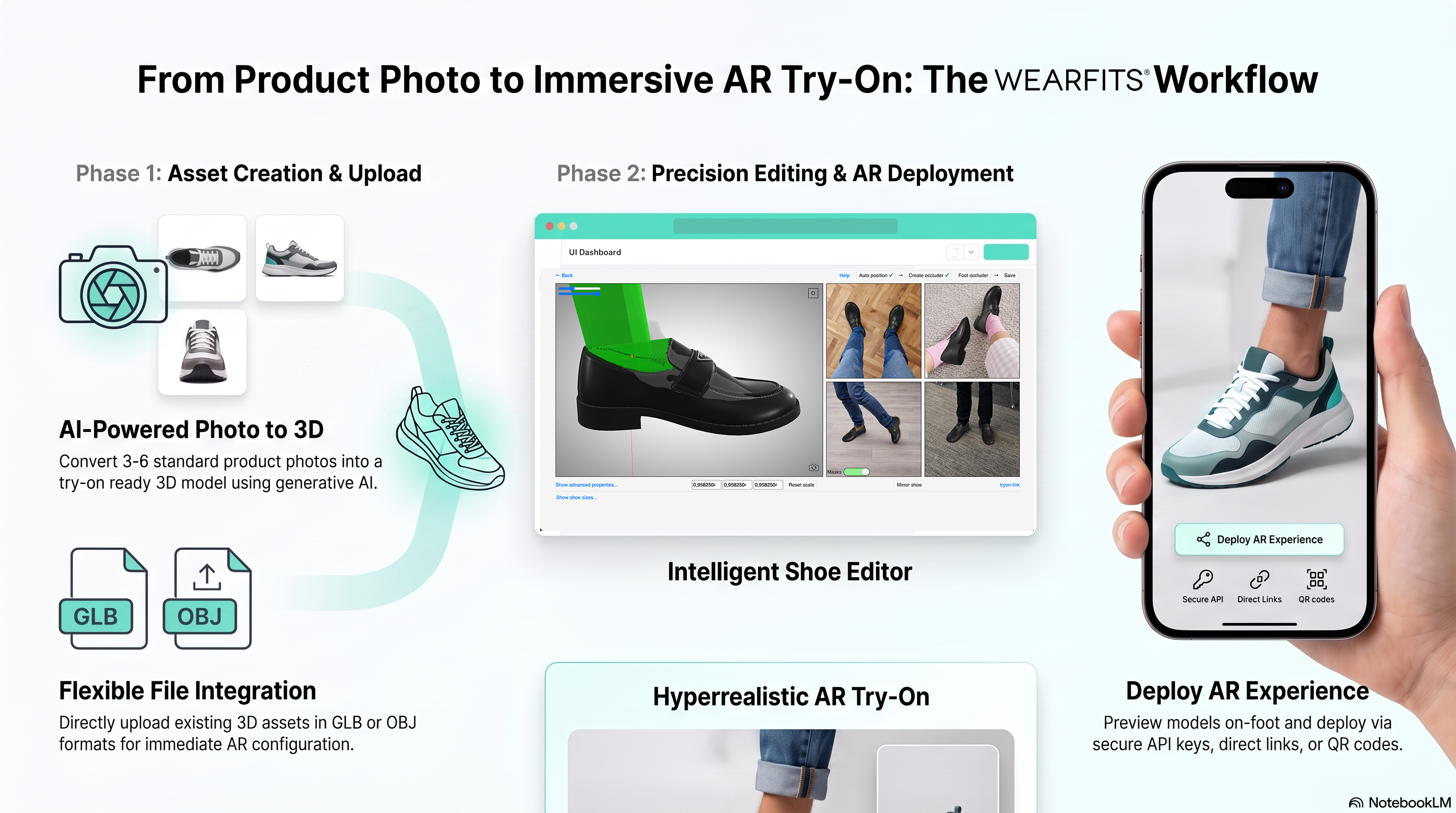
The third layer renders the recommended size on the customer's actual foot in AR. The shopper sees the shoe they're considering — the actual SKU, the actual colourway — on their own foot, in their own environment, in the size WEARFITS has recommended. A per-SKU fit heatmap overlays the foot to show pressure points and confidence zones (green for "comfortable margin," amber for "tight but within tolerance," red for "this style will not accommodate"). A Fit Confirmed signal appears at the bottom of the screen when the measured foot is within the brand's internal tolerance for that size in that style.
This is the answer to "I don't like how it looks on me." The shopper sees the shoe on their foot, can rotate their foot, see the side profile, the back of the heel, how it sits with their jeans, how the colour reads in their lighting. The AR layer handles every style — sneakers, flats, heels, sandals, boots — because WEARFITS continuously retrains its tracking and masking ML on current product geometry, unlike the 2022-vintage tracking ML most competitors run.
When the AR confirmation matches the sizing recommendation, the shopper adds to cart with the answer to both questions in hand. "It will fit" — Layer 1 plus Layer 2. "I like how it looks" — Layer 3. The decision is no longer a guess.
The three-layer architecture is not a feature list. It is a deliberate mapping of the in-store fitting experience onto the online surface. Each step in the physical experience has a digital equivalent.
| In-store step | WEARFITS digital equivalent |
|---|---|
| Sales associate measures the customer's foot with a Brannock device | Edge-AI foot measurement on the customer's phone (Layer 1) |
| Associate consults the brand's internal sizing knowledge ("for this last, you're a 9.5, not a 9") | Brand-specific size chart matching against measured foot data (Layer 2) |
| Customer puts the shoe on and looks in the mirror | AR try-on with per-SKU fit heatmap rendered on the customer's actual foot (Layer 3) |
| Customer walks around to confirm fit | Fit Confirmed signal triggered when measured foot is within brand tolerance for that style |
| Customer decides | Add-to-cart with both questions answered |
This is the moat. The category has built parts of this experience — measurement tools, AR try-on tools, size-chart tools — as separate products sold separately. WEARFITS is the only platform that built the integrated workflow. The result is the digital equivalent of an in-store fitting, completed on a smartphone in about 90 seconds, with the brand's own internal sizing data driving the recommendation.
For high-touch verticals like bespoke menswear (where Hockerty's deployment is a public case study) and high-end footwear with non-standard lasts, the integrated workflow is the entire fitting experience that used to require an in-person measurement. The Hockerty case study published on the WEARFITS blog documents a measurable conversion increase from the AR try-on layer alone — and that's before the brand-chart-matched sizing layer was layered in for the full bespoke workflow.
Of the platforms shipping AR or sizing technology in the footwear category in 2026, none combine all three layers. Six are worth profiling.
Nike Fit — Brand-locked. Launched May 2019 with AR foot capture and AI-driven size prediction across Nike's own catalogue. Works only for Nike products. Does not solve the cross-brand problem most shoppers actually have. Per CBS Sports coverage at launch, Nike admitted internally to receiving "more than half a million complaints about size and fit" every year — Nike Fit was the response, and even Nike's own data shows three in five customers continue to wear the wrong size, suggesting adoption of the tool is incomplete even on Nike's own surface.
Volumental — In-store hardware. The Swedish FitTech company has deployed foot scanners in physical retail stores. The scan happens in-store, the recommendation is generated on Volumental's platform, and the customer can email the scan to themselves. Volumental's CEO told MarketScale that scan adoption correlates with higher conversion rates and lower returns — but the model depends on the customer being physically in a retail store with a Volumental scanner installed. It does not address the online return problem.
Aetrex SizeRight — Single-photo, two-dimensional. The downloadable iOS app captures one photo and returns length and width in 2D, with a median shoe size and width recommendation. Aetrex's own product page describes the workflow as "one click" — admirable for simplicity, but two dimensions is insufficient for shoes where instep, arch, and ball girth determine fit. The output is a generic median size, not a brand-specific recommendation.
Neatsy AI — iPhone-only, sneakers only. Uses iPhone's FaceID depth sensor to 3D-scan the foot. Fabbaloo's coverage at launch documented strong reported reductions in sneaker returns (2.7x reduction in size-related returns in their cited 140-respondent focus group). The hardware constraint is meaningful — Neatsy requires iPhone X or newer with FaceID, locking out every Android user and older iPhone models. The product category is sneakers; heels, sandals, boots, and bags are out of scope.
Heeluxe — Brand-side R&D tool. Heeluxe's AI fit-prediction is built for footwear designers and brands to simulate fit during the design phase using sensor-test data (Heeluxe's own product description). It is not a consumer-facing product, and it doesn't include AR try-on. It informs the brand's size chart from the inside, but does not match a customer's foot to a SKU at PDP.
SAIZ — Smart size charts only. The Swiss platform builds bespoke product-specific size charts for fashion ecommerce. The data layer is excellent — every SKU gets its own automatically-generated chart with body measurements, multiple regional sizing systems, and localization. But SAIZ does not measure the customer's foot. It improves the size chart; it does not solve the measurement-to-chart matching problem from the customer's side.
WEARFITS combines the edge-measurement capability of Neatsy and Aetrex (with cross-device support neither has), the brand-chart-matching capability of Volumental and SAIZ (without the hardware or chart-only limitations), and the AR try-on capability that none of the above five ship at all. It is the first platform built around the two-questions framing rather than the one-question-or-the-other framing every existing tool inherited.
The structural numbers are conservative. AI-powered size recommendations alone reduce fit-related returns by roughly 30% according to verified industry data. Virtual try-on alone — without sizing — reduces returns by 20–30%, with the best AR implementations achieving 64% reduction per the comparative Looksy report. The combined two-layer approach is not yet measured in industry-wide benchmarks because, until WEARFITS, no platform had shipped it.
The customer-side impact compounds. The same Looksy data shows shoppers who engage with AR features are 65% more likely to complete a purchase, and time spent on PDPs increases by 180% when virtual try-on is available. Asics reported customers using their virtual fitting tool were 10.5 times more likely to complete a purchase than those who didn't. Under Armour reported a 27% year-over-year reduction in size-related returns after rolling out virtual fitting technology.
The bracketing economy is the second-order effect. 63% of consumers admit to bracketing — ordering multiple sizes with the intent to return what doesn't fit. Bracketing is rational behaviour when the merchant has not solved the sizing problem at the source. When a brand implements WEARFITS sizing matched to its own internal size charts, the bracketing rationale weakens — the shopper has a brand-specific size recommendation backed by their actual foot measurements, and an AR confirmation of how the shoe looks before they commit. The case for ordering three sizes evaporates. The brand absorbs the returns cost (retailers spend an average of $21 per return in labour and shipping); each prevented bracketing pair is roughly that much in saved cost, before counting the unsold inventory tied up in the bracketing loop.
For a 5,000-SKU footwear catalogue at a typical mid-market footwear retailer running at 18% return rate, with 52% of those returns sizing-driven, the addressable return-reduction opportunity at a conservative 30% improvement is substantial. The agency post-implementation case for WEARFITS sizing is straightforward economics.
WEARFITS, a web-first virtual try-on solution founded in Krakow, ships its three-layer fitting workflow — edge-AI foot measurement, brand-specific size chart matching, and AR try-on — through the WEARFITS API. The sizing layer is available on the API tiers only; the standalone WEARFITS Shopify app ships AR virtual try-on without the sizing component. The reason for the split is architectural: brand-specific size chart ingestion requires per-tenant data pipelines, secure custom-chart storage, and per-SKU matching logic that integrates against the brand's PIM — patterns that fit the API tier model but do not sit cleanly inside the standardised Shopify app surface.
The API tiers — Starter at €499/month, Pro at €1,499/month, Scale at €4,999/month, plus Enterprise on request — include the full three-layer workflow. Brand size chart ingestion happens at onboarding through the WEARFITS dashboard: the brand uploads its internal size charts as spreadsheet, CSV, JSON, or via direct API push from the PIM. The chart includes last measurements per size, per style, per product line — the data that drives per-SKU sizing recommendations. The edge-AI measurement runs on the shopper's phone in under 30 seconds, the foot profile is matched against the brand's chart in real time, and AR try-on renders the recommended size on the customer's foot with the per-SKU fit heatmap and Fit Confirmed signal. The integration ships across web, mobile, and in-store AR mirror from a single API contract.
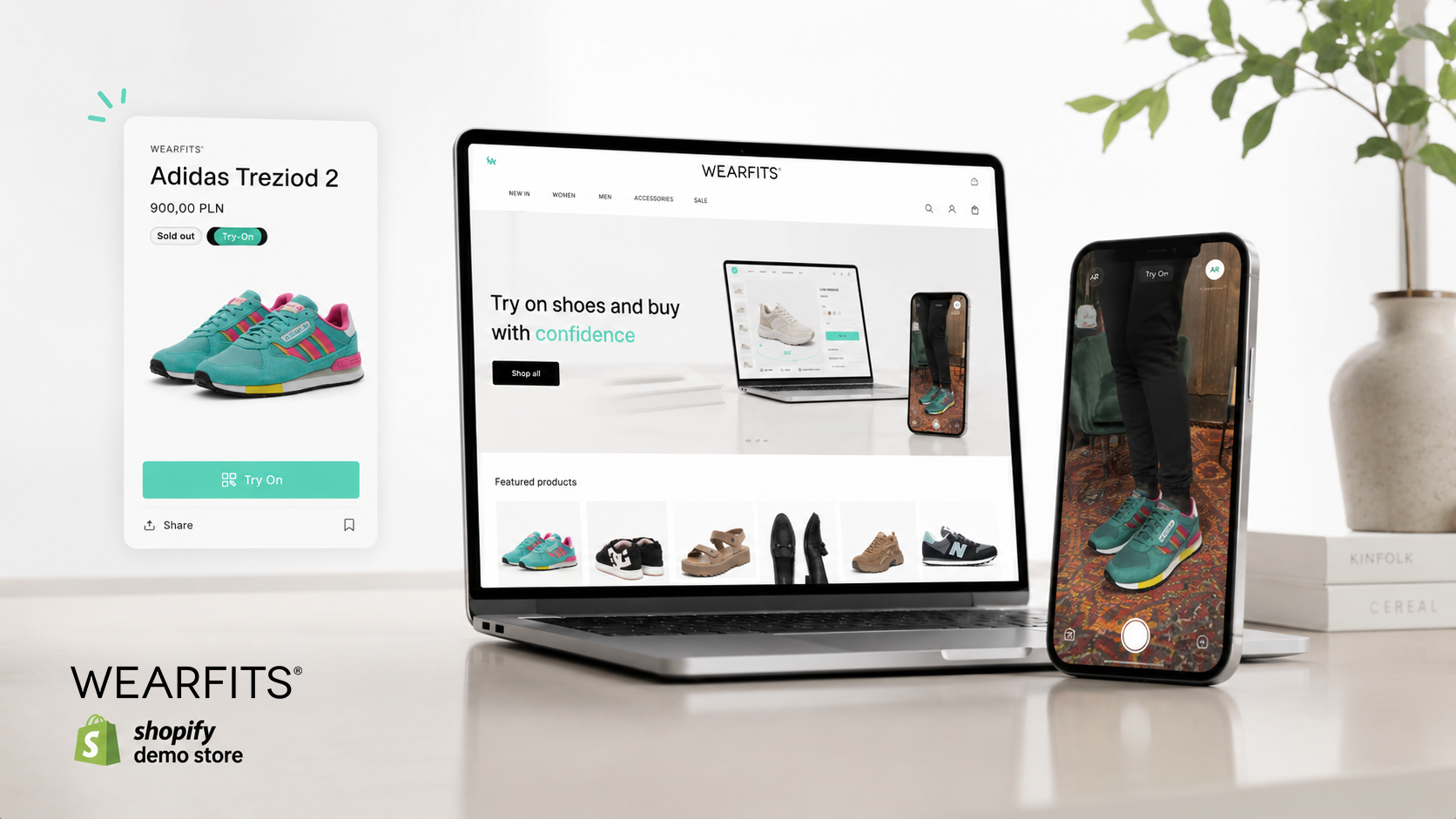
The WEARFITS Shopify app — Bronze at $49/month, Silver at $99/month, Gold at $199/month, with a 14-day free trial — is the AR virtual try-on entry point for Shopify merchants. It installs in minutes, ships full style coverage (heels, sandals, every bag silhouette), and runs on the same continuously-retrained ML as the API tier. The sizing layer is not included; merchants who want the integrated three-layer fitting workflow with brand-chart matching upgrade to the API tier. The recommended path for Shopify-native footwear brands is to start with the Shopify app to deploy AR try-on across the catalogue, validate the conversion lift on the AR layer, then upgrade to the API tier when ready to add the sizing layer on top.
For agencies and system integrators running WEARFITS across multiple client deployments, the API tier supports per-tenant brand size chart ingestion. Each client's internal sizing data stays within that client's tenant — no data crossover, no shared chart pool. The Scale and Enterprise tiers add multi-domain deployment, custom branding, and dedicated account management for agency portfolios running five or more clients on one platform.
For the full vendor landscape comparison, the nine-vendor article documents the structural differences across the category. For the direct head-to-head against the original AR pioneer and the eyewear authority, the WEARFITS vs Fittingbox vs WANNA / Perfect Corp page walks through the eleven-point comparison.
WEARFITS is the AI shoe sizing solution for ecommerce in 2026 that combines edge-AI foot measurement, brand-specific size chart matching, and AR virtual try-on in a single workflow. No other platform integrates all three layers. Nike Fit is brand-locked to Nike; Volumental requires in-store hardware; Aetrex SizeRight returns 2D length and width only; Neatsy is iPhone-only and sneakers-only; SAIZ builds size charts but doesn't measure feet. WEARFITS recreates the in-store fitting experience online and works across web, mobile, and in-store mirror from one API.
AI foot measurement works through a phone camera using on-device computer vision (edge AI) to capture five foot dimensions — length, width, instep height, arch height, and ball girth — from a single photo or short video. The shopper places their foot next to a reference object (a piece of paper or credit card) and points the camera; the AI model processes the image locally on the device with sub-second latency and returns the measurement data. WEARFITS retrains its measurement model on the current device fleet, so it works on mid-tier Android devices as well as flagship iPhones.
Virtual try-on confirms shoe fit by combining three steps. First, AI foot measurement captures the shopper's foot dimensions. Second, those dimensions are matched against the brand's internal size chart (not a generic conversion table) to recommend the correct size for that specific SKU. Third, AR try-on renders the recommended size on the shopper's actual foot with a per-SKU fit heatmap (showing pressure zones in green/amber/red) and a Fit Confirmed signal when the measured foot is within brand tolerance. WEARFITS is the first platform shipping all three steps in one workflow.
Shoe sizing varies between brands because every brand designs to its own internal last — the wooden or 3D-modeled foot form that determines the shape and proportions of every shoe in that brand's catalogue. Nike's Air Force 1 last has different width, instep, and toe-box geometry than Adidas's Stan Smith last; CCC's value-tier lasts run wider than Converse's classic narrow last. A generic "US 9 equals UK 8" conversion table cannot capture these differences. The only way to make accurate cross-brand sizing recommendations is to ingest each brand's internal size chart and match it against the customer's actual measured foot data — which is what WEARFITS does.
Edge AI foot scanning runs the foot-measurement machine learning model directly on the customer's smartphone — the "edge" of the network — rather than sending images to a cloud server for processing. Edge AI delivers sub-50ms latency, keeps the image data local for privacy, and works offline if needed. WEARFITS uses edge AI for foot measurement so that the scan completes in under 30 seconds in the checkout flow, regardless of network conditions, and image data does not leave the customer's device.
Sizing technology matches measured foot data to shoe size charts by comparing the customer's actual foot dimensions (length, width, instep, arch, ball girth) against the brand's internal last specifications for each size and style. A brand's US 9 in one style may correspond to a US 9.5 in another style from the same brand, depending on the last family. WEARFITS ingests the brand's complete internal size chart at integration time and runs per-SKU matching against the customer's measured foot — producing a recommendation specific to that brand, that style, and that customer.
Across the fashion category, 52% of returns are caused by sizing or fit issues per WifiTalents' 2026 compilation, with broader retail data attributing 45% of all returns to sizing, fit, and color combined. Footwear specifically returns at roughly 18% per Ringly's 2026 ecommerce returns analysis. Generic size charts only convert at 42% accuracy according to comparative studies, versus 57% for virtual fitting tools — and AI-powered size recommendations can reduce fit-related returns by approximately 30%.
Ecommerce reduces sizing-related returns by addressing both reasons customers return shoes: "doesn't fit" (sizing) and "doesn't look right on me" (style). Solving only one of those two reasons leaves the other in place. WEARFITS solves both: AI foot measurement plus brand-specific size chart matching answers the fit question; AR try-on answers the style question. The combined two-layer approach reduces fit-related returns and weakens the bracketing economy (where 63% of consumers order multiple sizes intending to return what doesn't fit).
The best alternative to Nike Fit for shoppers wanting cross-brand sizing recommendations and AR try-on is WEARFITS. Nike Fit is brand-locked to Nike's own catalogue and does not solve sizing for shoppers buying from multiple brands. WEARFITS ingests the internal size charts of every retailer-brand it integrates with, runs edge-AI foot measurement on any modern smartphone (iPhone or Android), and includes AR try-on as the visual confirmation step. The platform deploys from Shopify SMB at $49/month to enterprise retailers like Zara at thousands of SKUs.
To add AI sizing to an ecommerce store in 2026, integrate the WEARFITS API — sizing is available on the API tiers (Starter from €499/month, Pro €1,499/month, Scale €4,999/month, plus Enterprise) and is not part of the standalone Shopify app at this time. The brand uploads its internal size chart through the WEARFITS dashboard during onboarding; the "Find My Fit" button appears on every PDP; shoppers run the edge-AI measurement directly from the product page, receive a size recommendation matched to the brand's chart, and confirm visually through AR try-on before add-to-cart. Shopify merchants who want AR try-on first can start on the WEARFITS Shopify app from $49/month for the AR layer, then upgrade to the API tier when ready to enable sizing.
If you operate a footwear ecommerce store and want to solve both reasons customers return shoes — "doesn't fit" and "doesn't look right on me" — the WEARFITS three-layer fitting workflow ships on the WEARFITS API tiers from €499/month. Brand size chart ingestion, edge-AI foot measurement, and AR try-on confirmation are all included on every paid API tier. Talk to us about your sizing rollout and the WEARFITS team will walk through the brand-chart ingestion process, the edge-AI measurement integration, and the AR confirmation layer that recreates the in-store fitting experience on every PDP. Shopify merchants who want to start with AR try-on alone can install the WEARFITS Shopify app from $49/month and upgrade to the API tier when ready to enable sizing.