Shopify
AR Try-On
2D-to-3D


At WEARFITS, we believe the future of e-commerce goes far beyond static product photography. Fashion shoppers no longer want to simply browse products — they want to experience them. As digital commerce evolves, immersive technologies like Virtual Try-On (VTO) and Augmented Reality (AR) are becoming essential tools for brands looking to increase engagement, improve conversion rates, and reduce returns.
For years, however, scaling virtual try-on across an entire catalog remained a major challenge. Traditional 3D production workflows were too expensive, too slow, and too complex to support large inventories. Most brands could only afford to create digital assets for a small selection of hero products, leaving the majority of their catalog locked in static imagery.
Today, that limitation is disappearing. Thanks to AI-powered 3D-from-photo technology, WEARFITS enables brands to transform standard product photography into high-quality digital twins at scale — making immersive commerce accessible for entire collections, not just individual campaigns.
Before AI-driven automation became available, creating 3D assets was an extremely resource-intensive process. Brands often relied on specialized 3D artists, CAD modeling teams, or photogrammetry studios to manually reconstruct products. While these methods could deliver impressive visual quality, they introduced significant operational challenges.
For fashion retailers managing hundreds or thousands of SKUs, traditional 3D production quickly became unsustainable.
Manual modeling workflows scale linearly with inventory size. The more products a brand wanted to digitize, the more time and money were required. This made full-catalog virtual try-on financially unrealistic for most companies.
Complex 3D pipelines often added weeks of delay between photography and product launch. Coordinating external vendors, preparing assets, and reviewing models slowed down go-to-market timelines — especially for brands operating on fast seasonal schedules.
Many retailers were forced to maintain separate workflows for e-commerce photography and 3D asset production. This duplication increased operational complexity and created inconsistencies between channels.
At WEARFITS, we built our platform specifically to eliminate these bottlenecks.
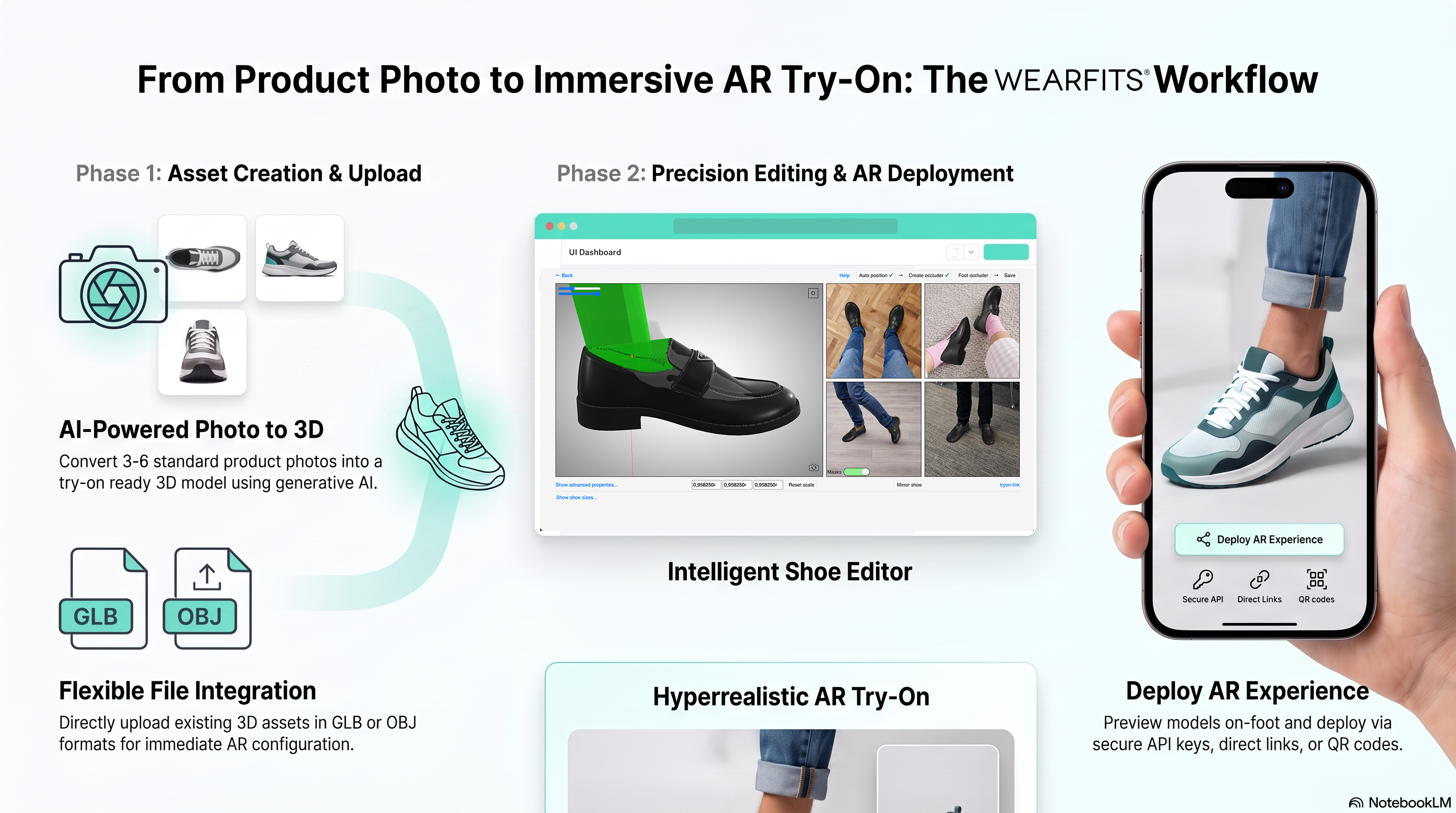
3D-from-photo, also known as image-to-3D generation, uses artificial intelligence (AI) to reconstruct realistic 3D models directly from standard 2D product images. Instead of requiring dedicated 3D design teams or specialized hardware, AI algorithms automatically generate lightweight digital assets ready for real-time applications.
This process analyzes product geometry, textures, proportions, and structural details using multiple photographs captured from different angles. The result is a highly optimized 3D file suitable for mobile AR, virtual try-on experiences, product viewers, and immersive campaign content.
At WEARFITS, we designed this workflow to integrate seamlessly into the existing production pipelines brands already use. The same images created for e-commerce listings can now power interactive shopping experiences across multiple customer touchpoints.
Our platform can digitize up to 100 products in as little as two hours, allowing fashion brands to scale immersive commerce at the speed modern retail demands.
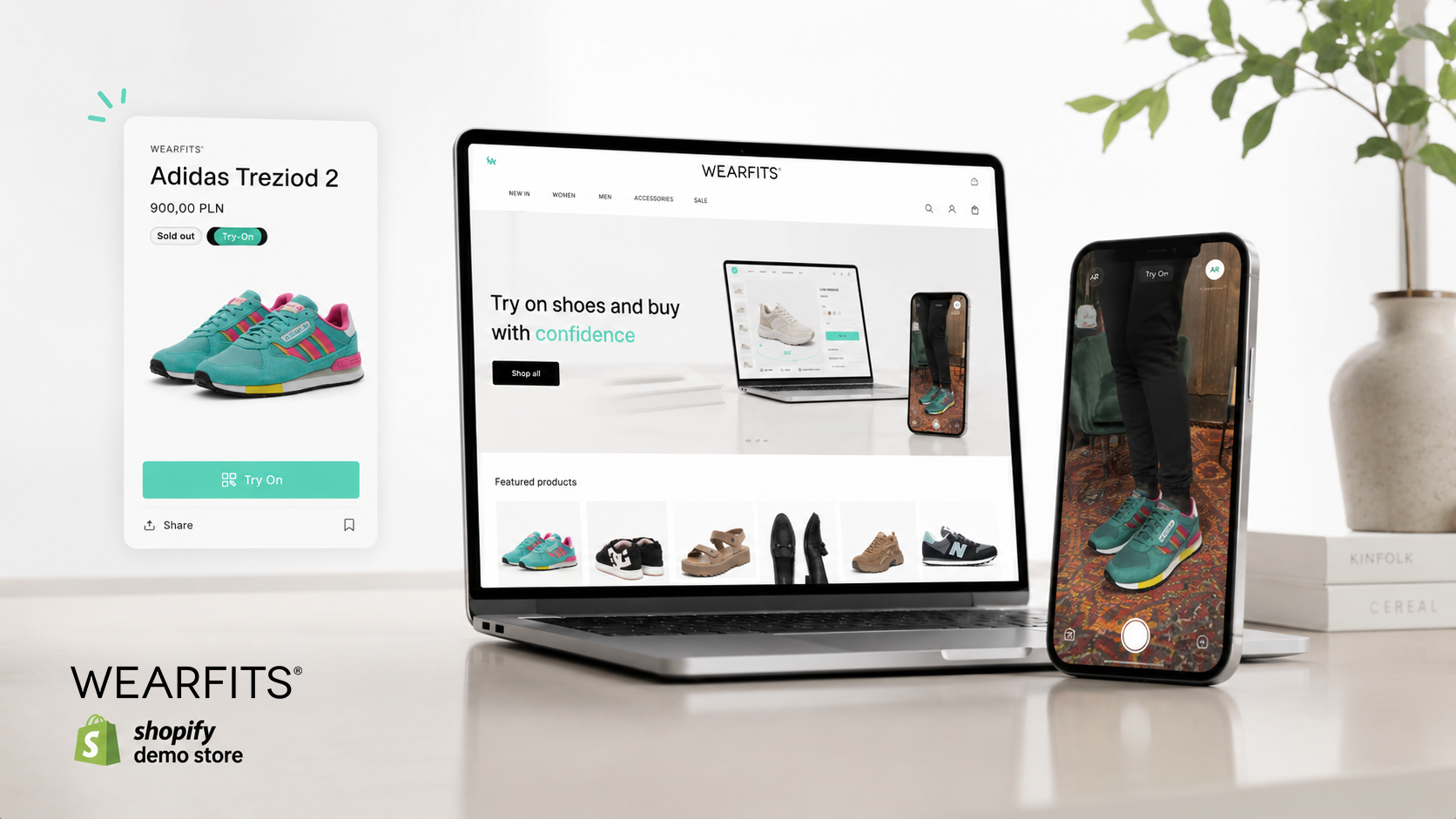
For brands using Shopify, implementing full-catalog virtual try-on no longer requires complex development projects or dedicated technical teams. WEARFITS streamlines the process into three simple steps.
Merchants can install the WEARFITS application directly from the Shopify App Store with minimal setup. No custom frontend coding or advanced infrastructure changes are required.
This allows brands to activate immersive shopping experiences quickly without disrupting existing storefront operations.
Instead of CAD files or expensive 3D scans, our AI reconstruction system works with high-quality product images on neutral or white backgrounds. By uploading multiple viewing angles, brands provide the AI with enough visual information to generate accurate digital twins automatically.
Because the process uses standard e-commerce photography, brands can integrate 3D generation directly into their current content workflows.
Once processing is complete, merchants can activate the “Try On” feature on selected product pages. Customers can instantly access AR experiences through their smartphones, allowing them to visualize products in real-world environments before making a purchase.
This workflow transforms 3D digitization from a specialized project into a scalable operational process.
Virtual try-on only works if customers trust what they see. Poor alignment, unrealistic scaling, or unnatural rendering quickly reduce confidence and make the experience feel gimmicky rather than useful.
At WEARFITS, realism is one of our highest priorities. Our VTO technology uses several advanced rendering techniques to create believable interactions between digital products and the physical world.
Digital products interact naturally with the user’s body and surroundings. Shoes can appear partially hidden beneath pant legs, while bags and accessories align correctly with body movement and positioning.
True-to-scale rendering ensures products appear in realistic proportions relative to the customer. This is critical for helping shoppers evaluate fit, size, and overall styling before purchase.
Our digital twins respond to real-world lighting conditions in real time, helping products blend naturally into the customer’s environment and increasing visual realism.
When these technologies work together, virtual try-on evolves from entertainment into a practical decision-making tool that increases purchasing confidence.
Scaling virtual try-on across an entire inventory delivers measurable commercial benefits that go far beyond visual innovation.
Interactive product experiences help customers make faster and more confident purchasing decisions. Better visualization reduces hesitation and improves the transition from product discovery to checkout.
One of the most common causes of returns in fashion e-commerce is the mismatch between customer expectations and the actual product experience. Virtual try-on allows shoppers to better understand scale, styling, and appearance before buying, reducing uncertainty and lowering return rates.
Immersive shopping experiences naturally encourage longer browsing sessions and deeper interaction with products. Customers spend more time exploring collections and developing stronger emotional connections with the brand.
Digital twins created through WEARFITS can be reused across websites, mobile applications, social campaigns, and in-store AR experiences. This creates a connected omnichannel ecosystem where customers can interact with products seamlessly across every touchpoint.
For example, a shopper may try on a product using an in-store AR mirror, scan a QR code, and complete the purchase later from their mobile device.
Although AI automates much of the reconstruction process, high-quality input photography remains essential for achieving the best possible results at scale.
At WEARFITS, we recommend several best practices for brands preparing products for digitization.
Providing images from several perspectives allows the AI to reconstruct accurate geometry and surface details.
Standardized lighting conditions improve texture consistency and enhance overall visual quality across collections.
White or clean neutral backgrounds simplify AI processing and help maintain focus on the product itself.
The most successful brands treat 3D generation as part of their standard photography process. This ensures new products are automatically prepared for virtual try-on as soon as they launch.
As AI reconstruction technology continues to improve, digital twins are becoming foundational infrastructure for modern commerce rather than experimental marketing tools.
At WEARFITS, we believe every fashion product will soon exist simultaneously in both physical and digital form. Brands that adopt scalable virtual try-on early will be better positioned to meet evolving customer expectations, create more engaging shopping experiences, and compete in an increasingly crowded market.
The transition from traditional e-commerce to immersive commerce no longer requires massive production budgets or months of technical implementation. With AI-powered workflows and existing product photography, brands can launch scalable AR shopping experiences in just days.
In today’s competitive retail environment, allowing customers to “try before they buy” is rapidly becoming more than a differentiator — it is becoming the new standard for digital commerce.