The fashion industry is experiencing a major transformation in the way digital product experiences are produced. For many years, turning a physical product sample into an interactive online experience involved a slow, sequential process: design the item, manufacture it, photograph it, and then market it through static imagery.
Today, products no longer exist solely in the physical world. They can also exist as digital twins—interactive, scalable digital assets that can be used across every customer touchpoint.
For many brands, however, the path from a standard packshot to a fully operational virtual try-on (VTO) experience has been restricted by what we call the “3D Model Tax.”
The 3D Model Tax: Why Traditional Workflows Fail at Scale
Until recently, the main challenge preventing widespread adoption of virtual try-on for shoes and bags was not the VTO technology itself. The real problem was the asset production pipeline.
Traditional 3D production depends heavily on manual modeling. A specialist 3D artist must recreate each product from the ground up using tools such as Blender or Maya.
For brands managing massive catalogs, the numbers quickly become unsustainable:
Cost: Manual 3D modeling generally costs between $200 and $800 per SKU.
Time: Producing a single footwear SKU can take approximately 15 to more than 50 hours of an artist’s time.
The Pilot Trap: Due to the high costs and lengthy production process, brands often begin with pilots covering only 8–10 “hero SKUs.” Six months later, the project may still include just those same 10 SKUs, while the remainder of the catalog continues to rely on static imagery. The result is a fragmented and inconsistent customer experience.
For a brand with a 500-SKU catalog, manual modeling can require an investment of around $200,000, along with a six-month delay before the first try-on experience is even launched.
In an industry driven by seasonal drops and frequent collection updates, this cannot be considered an efficient production pipeline. It is a bottleneck.
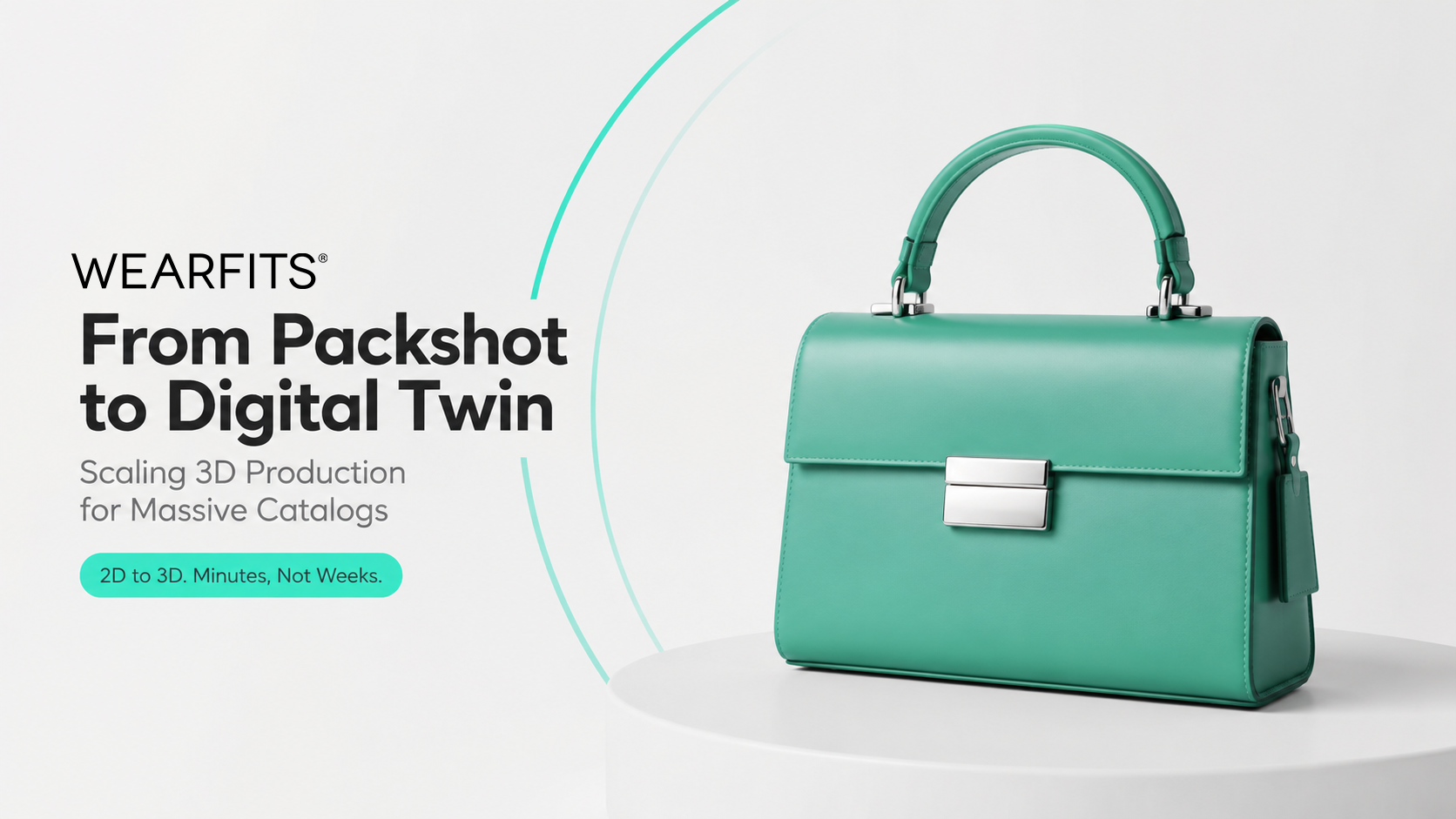
The WEARFITS Breakthrough: 2D to 3D in Minutes, Not Weeks
At WEARFITS, we developed an AI-driven 2D-to-3D pipeline specifically to eliminate this scaling challenge.
Instead of depending on manual sculpting or complex photogrammetry equipment, our workflow uses something every fashion brand already produces: product photography.
Our technology applies advanced algorithms to reconstruct a product’s geometry, texture, and structure directly from standard packshots.
No CAD files required: Brands do not need to provide manufacturing files, CAD models, or technical drawings.
No specialized hardware: There is no requirement for 3D scanners, photogrammetry rigs, or complicated studio installations.
100 SKUs in under 2 hours: In production environments, WEARFITS can digitize a complete collection of 100 products in less time than it may take to deploy a Shopify theme update.
By uploading only four standard packshot images photographed against a clean background, brands receive an AR-optimized digital twin prepared for mobile VTO.
This workflow is 10× faster than manual production, enabling product digitization to move at the same speed as seasonal merchandising cycles.
Why the Digital Twin Is Your Most Valuable Asset
A digital twin is not simply another 3D model. It is a reusable digital product layer.
Once WEARFITS creates a high-quality digital twin from your product photos, the asset becomes a core component of your commerce infrastructure.
A single 2D to 3D conversion can support:
Web-Based Virtual Try-On
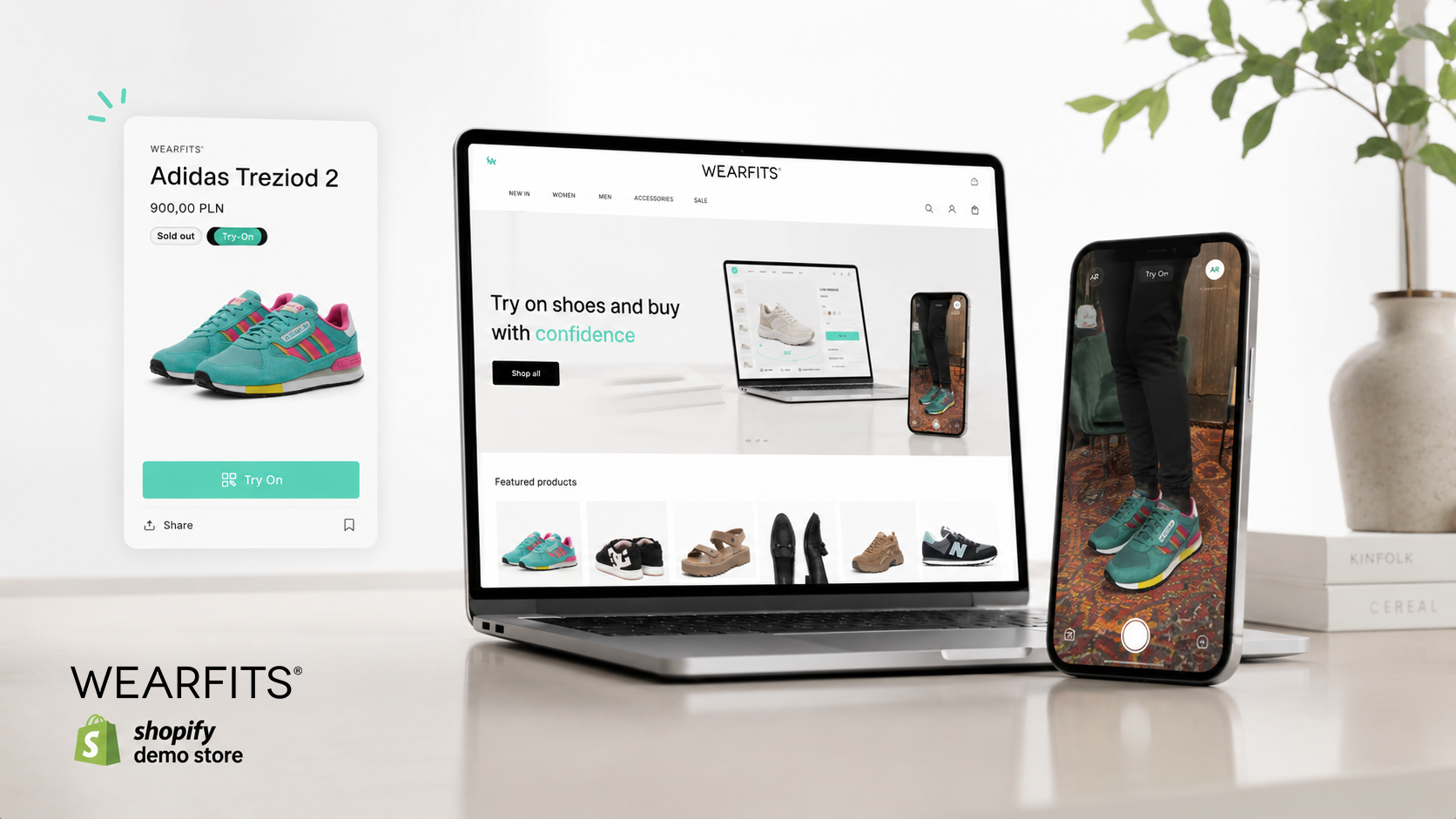
Brands can add a “Try On” button that launches immediately in mobile browsers such as Safari and Chrome, without requiring customers to download an app.
Omnichannel Deployment
The same digital twin can operate across a Shopify store, within a mobile application, and on in-store AR mirrors.
Marketing and Social Content
The asset can also be used to create high-fidelity renders for social media campaigns, 360-degree product viewers, virtual showrooms, and other digital marketing experiences.
Realism That Builds Purchase Confidence
One frequent concern about automated photo-to-3D pipelines is that the final output may appear artificial, unrealistic, or too “gamey.”
At WEARFITS, realism is a primary focus. When customers do not trust what they see, they are less likely to make a purchase.
Our hybrid 2D/3D rendering pipeline combines the photorealistic quality of the original 2D product images with the spatial precision of 3D geometry.
The pipeline includes:
Smart Occlusion: Shoes appear naturally beneath a trouser leg instead of looking as though they have been placed or “stamped” on top of the shopper’s foot.
Dynamic Lighting: The digital asset reacts naturally to the lighting conditions in the shopper’s real environment.
True-to-Scale Accuracy: Metric dimensions are retained, ensuring that a handbag, shoe, or other product appears at its actual size in relation to the shopper’s body.
This attention to detail is what transforms a “cool feature” into a genuine revenue feature.
Brands using the WEARFITS pipeline consistently experience a 20% to 30% increase in conversion and a 25% reduction in returns, as the digital twin removes much of the uncertainty associated with online shopping.
The Future of the Fashion Catalog Is Three-Dimensional
In 2026, static product photos are no longer the final stage of the digital product journey. They are the starting point.
The brands positioned to succeed will be those that view 3D not as an experimental luxury, but as a standard part of their commerce infrastructure.
WEARFITS allows independent fashion brands to compete with major retailers by removing the financial and technical barriers traditionally associated with 3D production.
Whether you operate a 50-SKU boutique or manage a 5,000-SKU enterprise catalog, our AI-powered 2D-to-3D pipeline provides the speed, scale, and cost savings required to transform an online store into a digital fitting room.
Ready to digitize your catalog?
Move beyond the “3D Model Tax” and begin building your library of digital twins today.