Virtual try-on (VTO) is no longer a novelty in fashion e-commerce—it’s becoming a core layer of digital commerce. In 2026, the real question is not whether to implement VTO, but which platform can actually scale and deliver business impact.
This guide compares four major players — WEARFITS, Fittingbox, WANNA (Perfect Corp.), Fibbl, Vyking, and DeepAR — through the lens of what truly matters today: scalability, integration, and measurable ROI. And importantly, it shows why a new generation of platforms like WEARFITS is redefining the category.
Why Virtual Try-On Matters More Than Ever
Online fashion still suffers from a fundamental problem: customers make decisions without context. Static images fail to communicate scale, fit, and style—leading to hesitation and high return rates.
Virtual try-on changes this dynamic by allowing shoppers to see products on themselves in real time. That shift has measurable consequences:
- Higher conversion rates
- Increased engagement and time on site
- Reduced returns driven by expectation mismatch
In fact, real-world deployments show return reductions of up to 30–35% when VTO is implemented effectively .
But here’s the catch: not all VTO platforms can deliver these outcomes at scale.
What Actually Differentiates VTO Platforms in 2026
The VTO market has matured. Visual quality is no longer enough. The real differentiators now are:
1. Scalability
Can the platform support thousands of SKUs—or only selected products?
2. 3D Asset Pipeline
Does it rely on manual 3D modeling, or automated generation?
3. Omnichannel Capability
Can the same system run across web, mobile apps, and in-store mirrors?
4. Integration Complexity
Does it require multiple SDKs—or a single unified integration?
5. Business Impact
Does it improve conversion, reduce returns, and drive revenue?
These criteria reveal a clear split between legacy VTO tools and next-generation commerce infrastructure.
Platform Comparison (2026)
WEARFITS — Built for Scale and Real Commerce Impact
WEARFITS represents a fundamentally different approach to virtual try-on. Instead of treating VTO as a feature, it treats it as infrastructure.
Key strengths
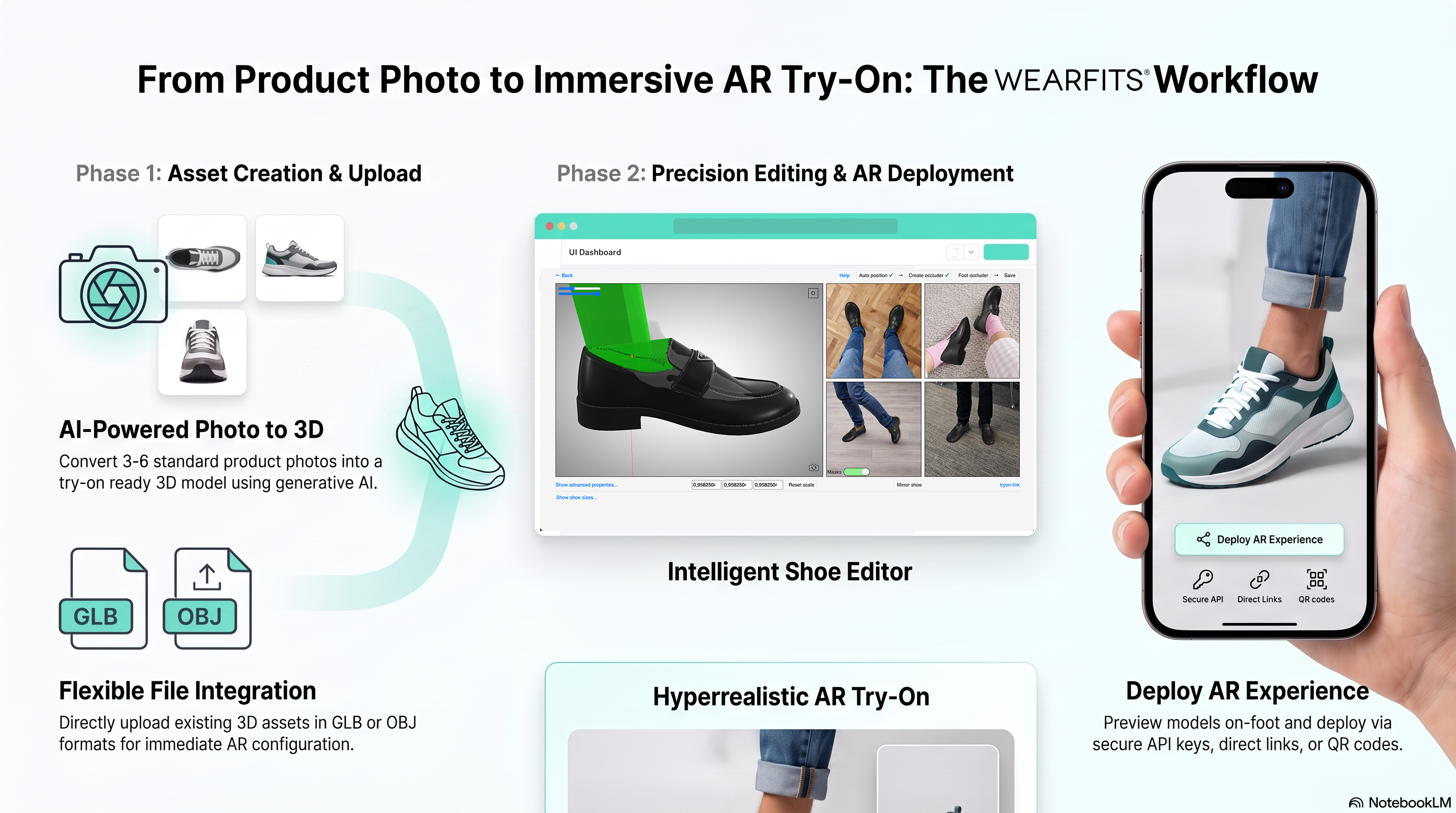
- 3D-from-photo pipeline
Generates 3D models directly from existing product images—no CAD or manual modeling required
- Full catalog scalability
Enables deployment across thousands of SKUs, not just selected items
- Web-first architecture
One integration works across web, mobile, and in-store environments
- Omnichannel deployment
Same system powers e-commerce, apps, AR mirrors, and even retail signage
- Performance-driven outcomes
Proven impact on conversion, engagement, and return reduction
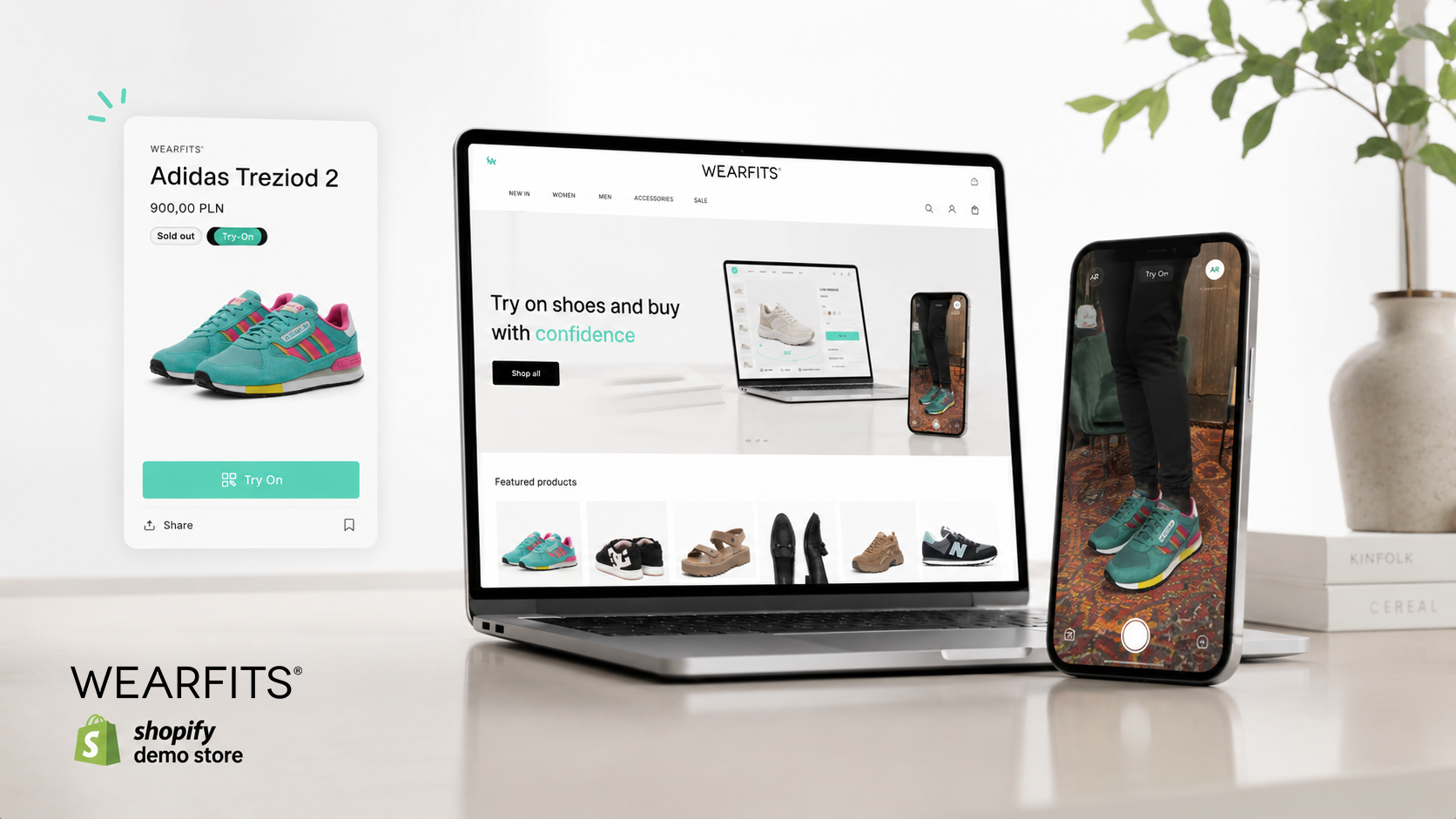
- Shopify try-on app for shoes and bags
WEARFITS allows retailers to install virtual try-on directly in Shopify.
It doesn't require programming skills
Why it stands out
The biggest limitation of traditional VTO platforms is the 3D bottleneck. Manual asset creation makes scaling expensive and slow.
WEARFITS removes this constraint entirely. Its AI-driven pipeline transforms packshots into digital twins, enabling:
- Faster product onboarding
- Lower production costs
- Consistent quality across catalogs
This is why WEARFITS is increasingly positioned not as a tool—but as core commerce infrastructure.
Fittingbox - Ultra-Realistic Solution for Eyewear and Footwear
Fittingbox is a specialized virtual try-on and 3D visualization software built for eyewear and footwear, with a strong focus on realism, live experience and product accuracy.
Strengths
- Large eyewear database combined with realistic 3D rendering for frames, lenses and materials
- Real-time virtual try-on with highly accurate face and product tracking
- Trusted by leading eyewear and footwear brands and retailers
Limitations
- Focused exclusively on eyewear and footwear
- Premium solution, therefore not the lowest-cost option on the market
Best for
Eyewear and footwear brands looking for ultra-realistic 3D assets, accurate live virtual try-on and a premium category-specific solution at scale.
WANNA (Perfect Corp.) — High-End AR Experiences
WANNA is one of the most recognized names in VTO, known for premium visual quality and strong brand collaborations.
Strengths
- High visual realism
- Strong presence across categories (shoes, accessories, beauty)
Limitations
- Scaling requires significant investment in 3D asset production
- Often used for campaigns rather than full catalog deployment
Best for
Large brands with a budget for curated, high-end experiences.
Fibbl — 3D Visualization First
Fibbl focuses heavily on interactive 3D product visualization, with try-on as an extension of that capability.
Strengths
- Strong 3D rendering and configurators
- Good for product exploration and customization
Limitations
- Dependent on traditional 3D workflows
- Scaling across large catalogs can be challenging
Best for
Brands prioritizing visualization and configurators over pure try-on.
Vyking — Footwear Specialist
Vyking is a specialized solution focused on footwear try-on.
Strengths
- Strong category-specific optimization
- Good user experience for shoes
Limitations
- Limited category coverage
- Scaling and omnichannel capabilities vary
Best for
Footwear brands looking for a focused, niche solution.
DeepAR — Developer-Centric AR Platform
DeepAR operates more as a toolkit than a full commerce solution.
Strengths
- Flexible SDK for building AR experiences
- Strong face and camera tracking capabilities
Limitations
- Requires significant development effort
- Not optimized for e-commerce workflows or catalog scaling
Best for
Companies with engineering teams that can dedicate themselves to creating augmented reality (AR) experiences.
The Real Shift: From Feature to Infrastructure
The biggest change in 2026 is not technological—it’s conceptual.
Old-generation VTO platforms:
- Built for demos and campaigns
- Focused on visual quality
- Limited by manual workflows
New-generation platforms (like WEARFITS):
- Built for full catalog deployment
- Designed for real commerce systems
- Optimized for measurable business outcomes
This shift is closely tied to the rise of digital twins in fashion, where every product becomes a reusable, interactive asset across channels .
Business Impact: What Actually Moves the Needle
When implemented at scale, VTO affects multiple layers of the business:
Conversion & Revenue
- +10–30% conversion uplift
- Faster purchase decisions
Returns & Costs
- Up to 35% fewer returns
- Lower logistics and operational costs
Engagement & AOV
- Higher session time
- Increased average order value
Retail Media & Monetization
- New ad formats (interactive try-on placements)
- Higher CTR and advertiser spend
This is why marketplaces and large retailers are adopting VTO not just for UX—but as a growth lever.
Final Verdict: Which Platform Should You Choose?
Choose WEARFITS if:
- You need to scale across hundreds or thousands of SKUs
- You want one system for web, mobile, and in-store
- You care about conversion, returns, and ROI
- You want fast, low-friction implementation
- You operate in footwear or bags, or in both categories
Choose Fittingbox if:
- You offer both eyeglasses and shoes
Choose WANNA if:
- You can invest in manual 3D production
Choose Fibbl if:
- Your focus is 3D product visualization
Choose Vyking if:
- You operate mainly in footwear
Choose DeepAR if:
- You want to build custom AR experiences
Final Thoughts
The VTO space is evolving quickly, but one trend is clear:
The winners will not be the platforms with the best demo—but the ones that scale across real commerce environments.
As fashion moves toward digital twins, AI-driven workflows, and omnichannel experiences, virtual try-on is becoming the layer that connects everything—from product content to customer decision.
And in that context, platforms like WEARFITS—built for automation, scalability, and measurable impact—are setting the new standard.
Interested in implementing virtual try-on for shoes, bags, or apparel? Contact our sales team: