Shopify
AR Try-On
2D-to-3D

Why we chose a web-first model for Virtual Try-On — and what that changes for clients
The virtual try-on market—especially in categories like shoes virtual try-on, bags, and accessories—has evolved rapidly over the past few years. What started as an innovation layer or marketing experiment is now becoming a core part of the digital commerce stack, directly impacting conversion, returns, and customer confidence.
In that context, one architectural decision keeps coming up in almost every buying conversation:
Should VTO be implemented through native SDKs or through a web-first model?
For a long time, the default answer across the industry was native SDKs—and for good reasons.
Most early virtual try-on solutions were built and validated in controlled environments. Native SDKs gave vendors direct access to device hardware, camera pipelines, and platform-level AR frameworks, which made it significantly easier to deliver stable tracking, smooth rendering, and visually convincing results—especially for demanding use cases like 3D shoes try-on.
This approach also aligned well with how VTO was sold: through demos. A native app running on a high-end device could reliably showcase the best possible experience, which helped build confidence during early-stage evaluations.
At the same time, the web was seen as a secondary channel. Browser-based camera access, permission flows, and inconsistent runtime behavior created the perception that web-based virtual try-on was inherently limited—suitable for simple product previews, but not for high-quality, real-time experiences.
As a result, many vendors built their offerings around separate iOS SDKs, Android SDKs, and sometimes additional solutions for in-store mirrors, effectively treating each channel as a different product.
What has fundamentally changed is not just the technology, but the expectations around how virtual try-on is used in production.
Brands implementing shoes virtual try-on today are not looking for a single-channel solution or a demo-ready experience. They are looking for:
In other words, VTO is no longer a feature—it is infrastructure.
This shift exposes a key limitation of the native SDK approach: while it performs well in isolated environments, it introduces fragmentation when scaled across real-world commerce systems.
In practice, choosing native SDKs often means committing to:
From a market perspective, this is where many VTO implementations start to slow down—not because the technology does not work, but because the cost of maintaining it across channels grows too quickly.
A web-first VTO architecture is often misunderstood as a simpler or “lighter” alternative to native SDKs. In reality, it is typically harder to build, because it requires solving performance, rendering, and machine learning challenges inside a constrained runtime—the browser.
Instead of relying on direct system-level integrations, you need to:
This is a fundamentally different engineering problem: instead of splitting complexity across platforms (iOS/Android), you concentrate it into a single runtime that must work everywhere.
So web-first is not easier. It is just a different kind of hard—one that shifts complexity from the client to the vendor.
From a client’s perspective, the most important question is not whether the system uses native or web technologies internally—it is how many integrations are required to make virtual try-on for shoes or bags work across all channels.
This is where the web-first model changes the product structure.
Instead of delivering separate SDKs for:
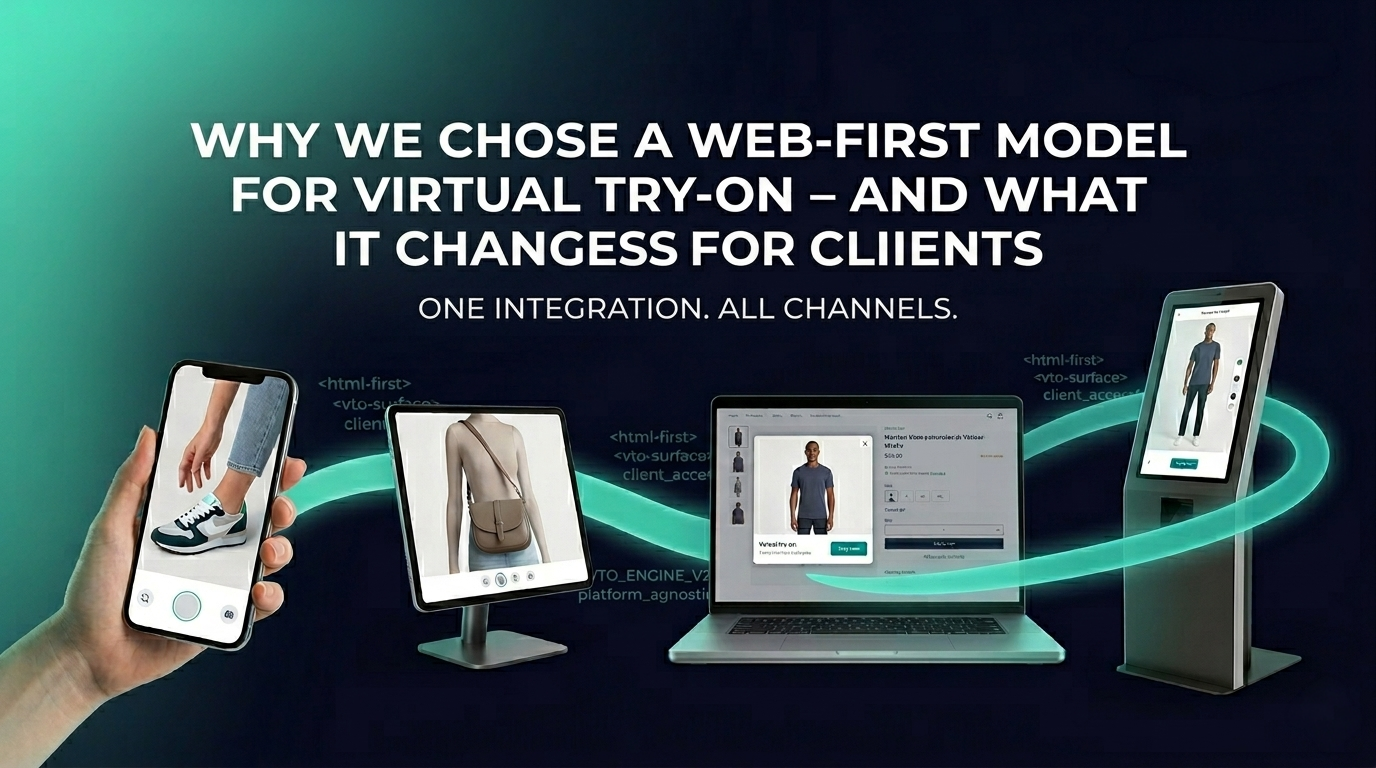
WEARFITS provides a single web-based integration layer that can be deployed across:
For shoes virtual try-on specifically, this enables multiple deployment formats from the same system:
The result is that clients integrate once and deploy everywhere, instead of building and maintaining separate platform-specific implementations.
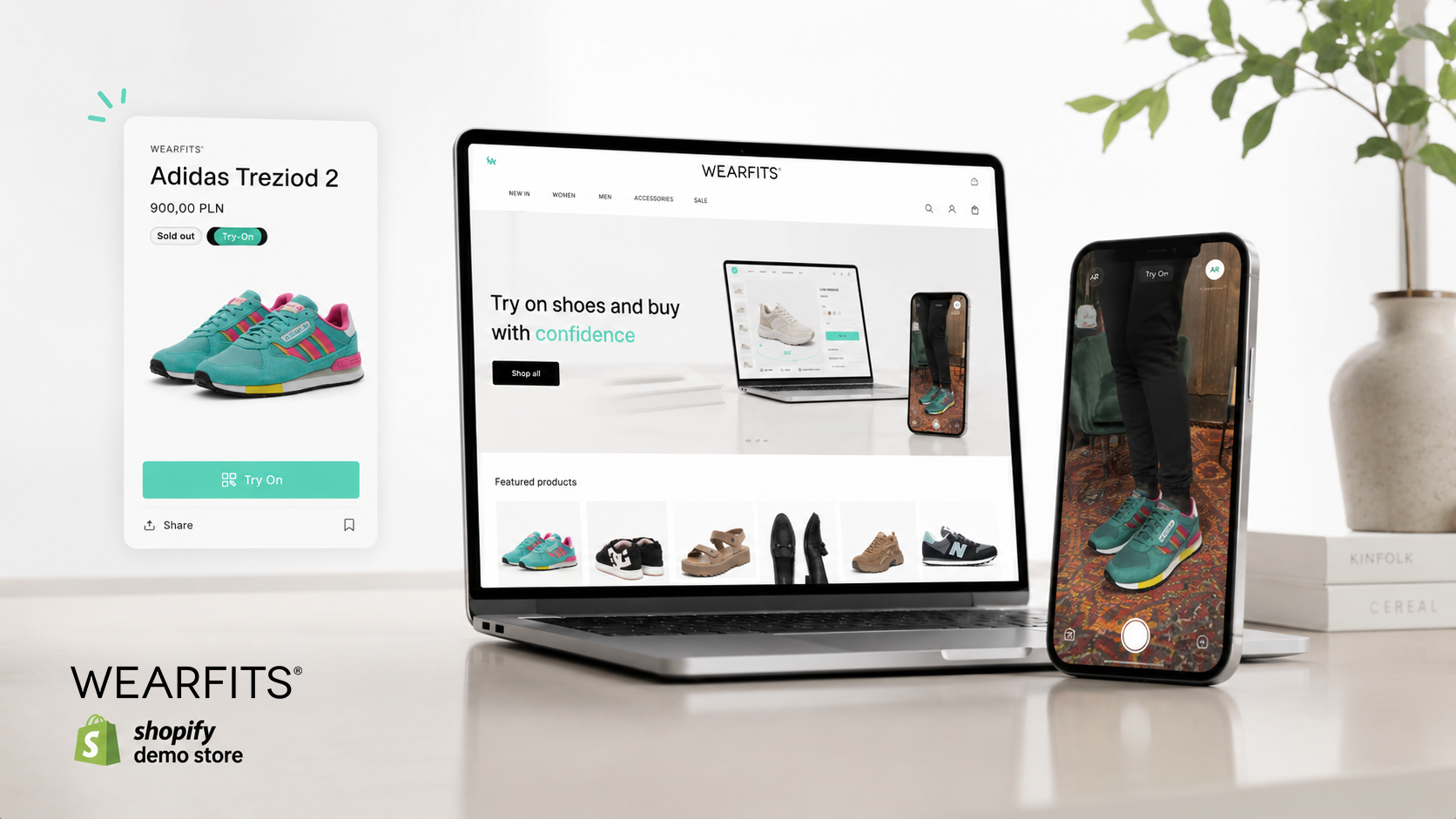
The web-based try-on solution opens the door to virtual fitting rooms for Shopify stores. After installing the WEARFITS Try-On Shopify app, merchants can seamlessly integrate and use the solution directly on their websites.
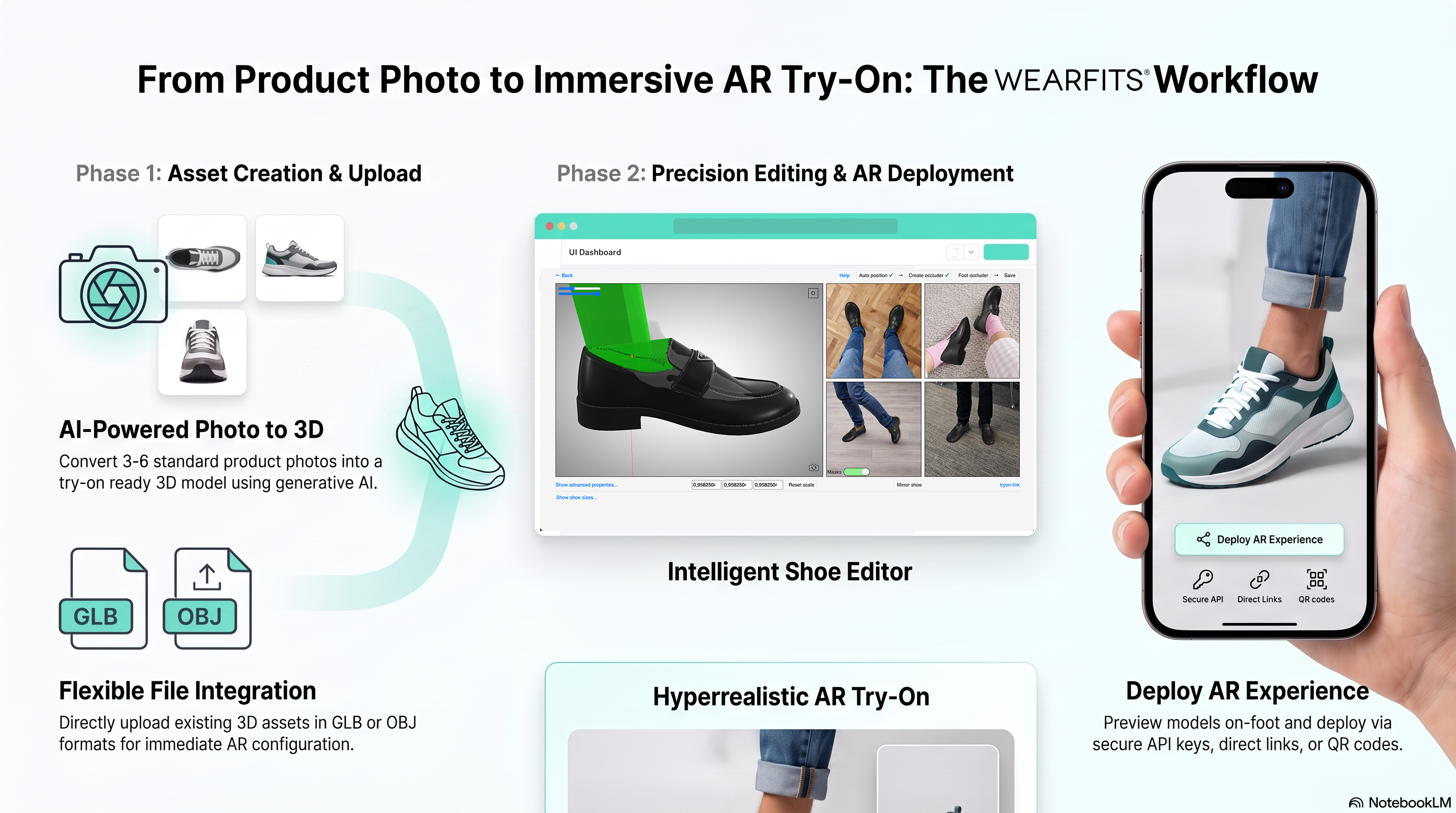
The process is fast and efficient — converting product photos into 3D (photo-to-try-on) and implementing try-on experiences for up to 100 pairs of shoes in a store can be completed in just a few hours.
Choosing the web as an integration model only works if it can match the performance and quality expectations of native solutions—especially in categories like 3D shoes try-on, where realism and responsiveness directly impact user trust.
The real breakthrough was not “using the web,” but making browser-based virtual try-on capable of:
A key concept here is adaptation. In a web-first system, you cannot assume uniform hardware. Instead, the runtime must dynamically adjust rendering complexity, model precision, and processing load to maintain a smooth experience across both high-end and lower-end devices.
This is particularly important in global e-commerce, where device diversity is the norm rather than the exception.
From a purely technical standpoint, native SDKs can deliver excellent results. But from a product and business perspective, they introduce a form of fragmentation that becomes increasingly costly over time.
For brands implementing shoes virtual try-on at scale, native SDKs often mean:
What starts as a performance-driven decision can evolve into an operational bottleneck, especially when VTO needs to be deployed across multiple channels and continuously updated.
In contrast, a web-first architecture centralizes this complexity into a shared runtime, reducing the number of integration points and making the system easier to scale and evolve.
The shift from native SDKs to a web-first model is not just technical—it directly impacts how VTO is deployed, maintained, and scaled.
From the client’s perspective:
This does not eliminate complexity entirely—browser environments still evolve, and platform-specific behavior still exists—but it consolidates that complexity into a single system instead of distributing it across multiple SDKs.
If you are evaluating a virtual try-on solution for shoes, bags, or accessories, the key question is no longer whether a vendor offers an SDK. The more relevant question is how their architecture performs in a multi-channel, production environment.
In practice, this means asking:
These are the questions that determine whether a VTO solution can scale beyond a demo and become a reliable part of your commerce infrastructure.
The real advantage of a web-first architecture is not just that it runs in the browser—it is that it provides one integration layer for shoes virtual try-on and beyond, reusable across channels, backed by a runtime sophisticated enough to deliver production-grade performance without fragmenting the system.
A native SDK approach requires separate iOS and Android implementations (and often a separate in-store mirror solution), each maintained on its own release cycle. A web-first virtual try-on runs in the browser, so a single integration covers e-commerce, mobile browsers, WebViews, iframes, and in-store screens. Native SDKs trade ease of integration for raw hardware access; web-first trades direct hardware access for unified deployment and lower long-term maintenance cost.
Because virtual try-on is no longer a marketing feature — it is infrastructure. Brands need shoes virtual try-on that works on the storefront, in mobile, in WebViews, and on in-store screens with the same source of truth. A web-first architecture is the only model that delivers that without forcing the brand into separate native workstreams per platform.
Not in production. Early web-based VTO had real limitations around camera access and rendering performance, which is where the “web is for simple previews only” reputation came from. Modern web-first VTO uses WebGL and WebGPU for real-time 3D, on-device machine learning for tracking, and adaptive quality with graceful fallbacks. On flagship devices in controlled demo conditions a native SDK can still look smoother — but in real-world production at scale, web-first delivers stable, high-quality shoes try-on across every channel.
One. A web-first model means a brand integrates once and deploys everywhere — storefront, mobile browsers, WebViews, iframes, in-store mirrors. Native SDKs typically require an iOS integration, an Android integration, and often a third integration for in-store screens, each with its own QA and release cycle.
Yes. The same web-based runtime that powers virtual try-on for shoes on the storefront also powers in-store mirror experiences. The brand gets one source of truth across digital and physical retail rather than separate native apps duplicating the same 3D assets and tracking logic.
Native SDKs do get more direct access to device hardware and platform AR frameworks. The trade-off is that this advantage only matters in narrow demo conditions. Web-first uses browser APIs for camera input and WebGL/WebGPU for 3D rendering — less raw access, but unified across platforms and engineered to handle real-world production loads.
Yes — shoes are one of the harder VTO categories because tracking happens on the foot, which moves in three dimensions and is often partially occluded. That is why WEARFITS solved foot tracking and adaptive rendering inside the browser runtime first, and why our shoes virtual try-on is production-ready rather than demo-only.
Native SDK costs compound: each platform release cycle, each iOS or Android update, and each platform-specific bug duplicates QA and engineering work. Web-first concentrates complexity in a single runtime that the vendor maintains. For clients, that translates to lower total cost of ownership and faster rollout of new features across every channel.