Shopify
AR Try-On
2D-to-3D
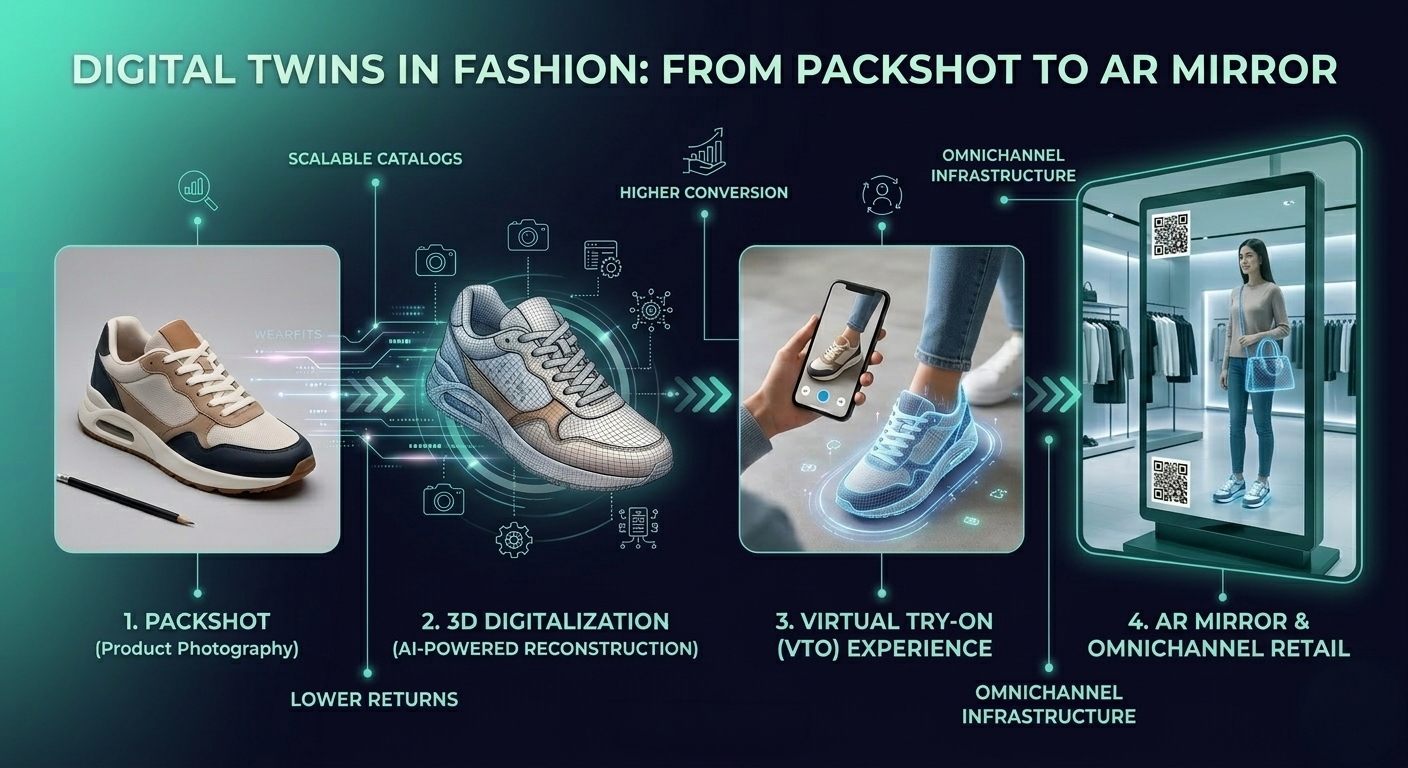

The fashion industry is undergoing a quiet but fundamental transformation. What used to be a linear process—design, produce, photograph, sell—is evolving into something far more dynamic. Today, products don’t just exist physically; they also exist as digital twins: interactive, scalable, and deployable across every customer touchpoint.
From a single packshot to a real-time AR mirror experience, this shift is redefining how fashion brands create, present, and sell products. And at the center of this transformation are technologies like 3D digitization, AI-driven modeling, and virtual try-on systems.
At its core, a digital twin in fashion is a virtual representation of a physical product that behaves like the real thing. It is not just a 3D model—it is a usable, interactive asset that can be rendered in real time, adapted to environments, and embedded into commerce experiences.
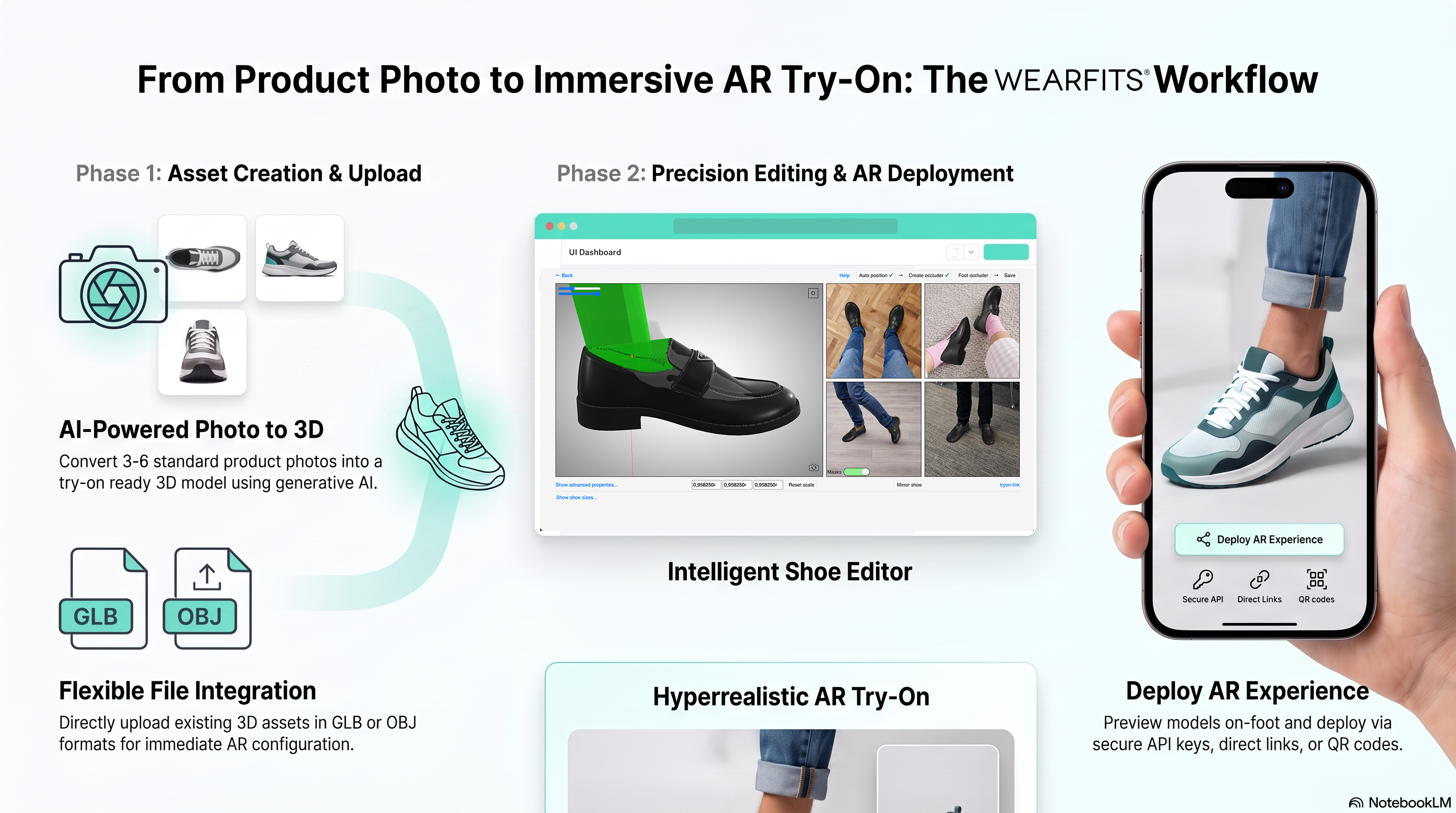
Traditionally, creating such assets required CAD files, manual 3D modeling, or complex photogrammetry setups. These approaches were accurate but slow, expensive, and difficult to scale. Today, however, the emergence of 3D-from-photo workflows has changed the equation entirely.
Instead of building assets from scratch, brands can now generate digital twins directly from product imagery—often using the same packshots already created for e-commerce.
This shift is what makes digital twins not just a technological innovation, but a practical one.
The journey of a digital twin begins with something every fashion brand already has: product photography.
With modern 3D digitization pipelines, a single image can be transformed into a fully functional 3D asset. These systems reconstruct geometry, texture, and structure directly from images, producing lightweight models that can be used in real-time environments.
This process unlocks a direct path from static content to interactive experiences:
The key advantage here is not just speed, but continuity. Instead of building separate pipelines for images, 3D, and AR, brands can extend a single content workflow into multiple formats.
As a result, digital twins retail strategies become scalable across entire catalogs—not just limited to hero products.
The importance of 3D digitization in fashion is closely tied to three challenges: speed, cost, and scale.
Fashion operates on rapid cycles. Collections change frequently, and product lifecycles are short. Traditional 3D workflows simply cannot keep up with this pace without significant investment.
3D-from-photo approaches address this by:
This is why many brands are shifting from viewing 3D as a premium feature to treating it as a standard output of their content pipeline.
In practical terms, digital twins are becoming as essential as product images once were.
A digital twin becomes truly valuable when it is activated inside an experience. This is where virtual try-on (VTO) plays a central role.
Virtual try-on uses digital twins to place products in context—on a customer’s body, in motion, and in real-world environments. This transforms the shopping experience from abstract to tangible.
Instead of imagining how a product might look, customers can see it instantly:
This shift has measurable effects. When customers understand products better, they make decisions faster and with greater confidence. This leads to:
In fact, real-world deployments show that improved visualization can significantly reduce returns and increase purchase confidence.
From a digital twins fashion perspective, VTO is the layer that connects digital assets to commercial outcomes.
The evolution does not stop at e-commerce. One of the most compelling endpoints of digital twins in retail is the AR mirror.
An AR mirror is essentially a screen with a camera and a browser-based try-on engine. It allows customers to interact with products in-store using the same digital twins that power online experiences.
What makes this particularly powerful is the underlying architecture:
This creates a truly omnichannel system, where the distinction between online and offline disappears.
A customer might:
From a retail perspective, this is more than a feature—it is a new infrastructure for commerce.
To understand why modern digital twins feel realistic and scalable, it is worth looking at the underlying technology stack.
Key components include:
Transforms images into structured 3D models without manual input.
Combines photorealistic visuals with accurate geometry for true-to-scale representation.
Ensures the product adapts naturally to different environments and lighting conditions.
Delivers consistent experiences across devices—from smartphones to large retail displays.
Together, these elements create digital twins that are not just visually accurate, but usable in real-time commerce scenarios.
One of the most important shifts happening today is conceptual: digital twins are moving from being a “nice-to-have” feature to becoming core infrastructure.
This is visible in how brands deploy them:
Modern systems are designed to scale across marketplaces, where thousands of SKUs need to be digitized and deployed without manual work.
This is where platforms like WEARFITS differentiate themselves—by focusing not only on visual quality, but on scalability, automation, and omnichannel deployment.
The goal is clear: make digital twins available for every product, not just selected ones.
While the technology is impressive, its real value lies in measurable business outcomes.
Digital twins in fashion contribute to:
For marketplaces and large retailers, the impact can be substantial, affecting GMV, advertising revenue, and operational costs simultaneously.
This is why digital twins are increasingly seen not just as a UX improvement, but as a growth lever.
Looking ahead, the trajectory is clear. As 3D digitization becomes faster and more accessible, the cost of creating digital twins will continue to drop, while their value continues to rise.
We are moving toward a model where:
In this world, the question is no longer whether to adopt digital twins in fashion, but how quickly they can be deployed across the entire business.
The journey from packshot to AR mirror represents more than a technological upgrade—it reflects a shift in how fashion products are created, experienced, and sold.
Digital twins connect content, commerce, and customer experience into a single system. They turn static images into interactive assets, and passive browsing into active engagement.
Most importantly, they allow brands to scale these experiences across entire catalogs, making immersive commerce not an exception, but the standard.
And that is what defines the next phase of fashion retail.