business


From September 15–17, 2026, the retail industry will meet in Paris for NRF 2026: Retail’s Big Show Europe — one of the key European events for retailers, technology companies, e-commerce leaders and brands looking for practical answers to the challenges shaping the next generation of commerce.
WEARFITS will be there in Hall 4, Stand ST-39, showcasing how AI, computer vision, WebAR and automated 3D technology can solve some of fashion retail’s most persistent problems: uncertainty around fit, high return rates, expensive product digitization and the gap between seeing a product online and understanding how it will actually look or fit.
Retail technology is moving beyond experimentation.
For years, technologies such as virtual try-on, AI-generated product experiences and 3D visualization have often been treated as interesting additions to the customer journey. Today, retailers increasingly expect them to deliver measurable business value.
Can they improve conversion?
Can they give customers more confidence before purchasing?
Can they reduce returns?
Can product visualization be introduced without creating an expensive and time-consuming content production process?
And, importantly, can these technologies be integrated into an existing e-commerce ecosystem without adding friction to the shopping journey?
These are exactly the conversations we expect to have at NRF Retail’s Big Show Europe.
The show brings together retailers, brands, technology providers and digital commerce decision-makers at a moment when the industry is actively looking for ways to combine stronger customer experiences with greater operational efficiency.
For WEARFITS, that makes Paris the ideal place to demonstrate not another AI concept, but technology designed for real retail environments.
One of the biggest challenges in online footwear remains surprisingly simple: customers are often unsure which size to choose.
That uncertainty has consequences throughout the retail business.
Footwear return rates can reach 20–30%, with a significant proportion of returns linked to sizing and fit. Every unnecessary return adds logistics costs, affects inventory availability, reduces margin and creates additional environmental impact.
WEARFITS approaches the problem from the customer’s perspective.
Instead of asking shoppers to guess their size based on a generic chart, our technology helps them understand how a specific shoe is likely to fit their individual foot.
The result is a more informed purchase decision — before the order is placed.
For retailers using WEARFITS, this can translate into meaningful business improvements, including approximately:
|
Business area |
Typical retail challenge |
Potential WEARFITS impact |
|
Returns |
High volume of size-related footwear returns |
~20% reduction in size-related returns |
|
Conversion |
Customers hesitate because they are unsure about fit |
~30% conversion uplift through higher sizing confidence |
|
3D production |
Traditional asset creation is slow and costly |
Up to 100 products digitized in under 2 hours |
|
Operations |
Returns create additional logistics and environmental costs |
Fewer unnecessary return cycles |
For larger retailers, improvements like these are not simply UX optimizations. They can directly influence margins, logistics costs, inventory efficiency and customer lifetime value.
At Stand ST-39, visitors will be able to experience one of the most advanced parts of the WEARFITS platform: footwear sizing combined with virtual try-on.
Our goal is to make the experience intuitive enough for consumers while keeping the technology behind it highly sophisticated.
Customers can scan their feet using a standard smartphone camera, without dedicated scanning hardware or an app download.
Our guided scanning process captures foot dimensions with up to 99% measurement accuracy within ±2 mm compared with professional scanning equipment.
For shoppers, the process feels simple.
For retailers, it creates something much more valuable: precise individual measurements that can be connected with product-specific sizing information.
A customer does not necessarily need another algorithm telling them to “buy size 42.”
They need to understand why.
WEARFITS uses a visual fit heatmap to show how a particular shoe is expected to fit the shopper’s foot. Comfortable areas and potential pressure points are communicated visually, translating complex sizing data into something immediately understandable.
Customers can also compare different sizes and half-sizes to see how the fit changes.
This turns sizing from an abstract recommendation into a much more tangible purchase decision.
Sizing answers one question: Will it fit?
Virtual try-on answers another: Will I like how it looks?
WEARFITS combines these experiences with WebAR technology that lets customers visualize footwear directly on themselves through their smartphone.
There is no application to download. The experience can become part of the existing e-commerce journey, helping retailers provide additional confidence without sending customers away from the product page.
A sophisticated virtual try-on experience is only useful if retailers can create product content at scale.
Historically, that has been one of the largest barriers to adopting 3D commerce.
Producing high-quality 3D assets manually can require specialist teams, considerable budgets and long production timelines — a difficult model for retailers managing hundreds or thousands of SKUs and rapidly changing seasonal collections.
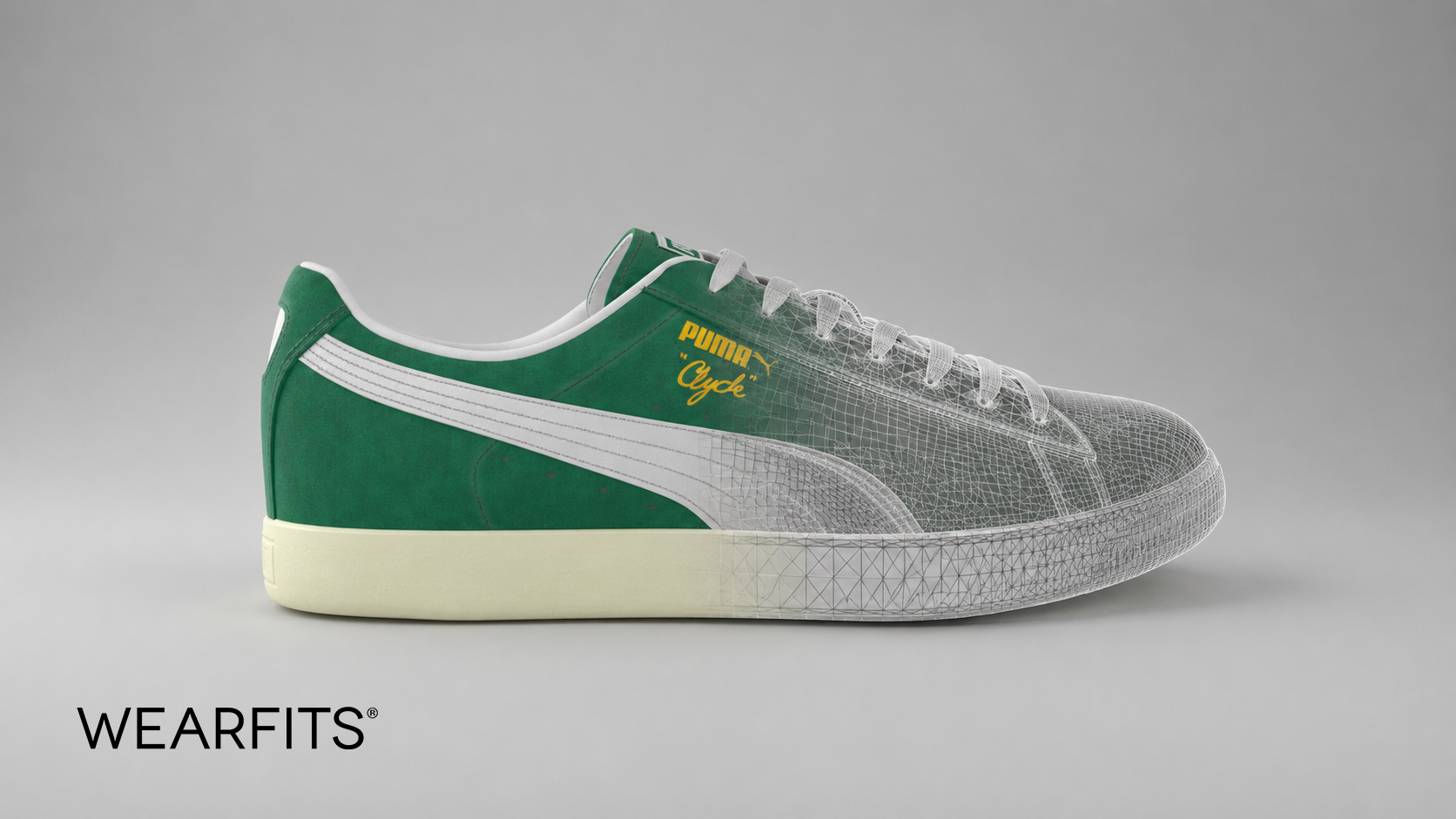
WEARFITS addresses that challenge with an automated 2D-to-3D digitization pipeline.
Using standard product photography, retailers can create high-fidelity, AR-ready 3D models much faster than through a traditional manual workflow.
A set of approximately 30 studio images can be converted into a detailed 3D representation of a product, enabling the digitization of up to 100 products in less than two hours.
That changes the economics of virtual try-on.
Instead of asking whether a retailer can afford to digitize a small selection of flagship products, the conversation becomes: how much of the assortment can we realistically bring into 3D?
Creating a 3D object is only part of the challenge.
It also needs to behave convincingly.
WEARFITS technology automatically positions footwear according to the user’s anatomy, maintaining realistic scale and alignment as the customer moves.
For accessories such as handbags, the platform can also simulate how products interact with the body. Customers can explore different ways of wearing an item, including handheld and over-the-shoulder views.
These details matter because online shoppers are not simply evaluating a digital object.
They are trying to imagine the product as part of their own life.
The closer digital commerce gets to answering that question, the smaller the gap between browsing and buying becomes.
Apparel introduces a different challenge.
Customers want to see the garment not on a generic model, but on themselves.
WEARFITS’ Generative AI Try-On enables shoppers to visualize garments using their own uploaded photo, creating a highly personalized representation of the product.
But believable AI try-on requires much more than simply generating an attractive image.
Our technology focuses on preserving the details that influence whether customers trust what they see.
The generated visualization preserves important characteristics of the user, including facial features, skin tone and body proportions.
The aim is not to create a different person wearing the garment. It is to help the shopper recognize themselves in the experience.
Fashion products often contain details that generic generative models can easily distort.
Collars, lapels, buttons, seams and garment proportions all influence how consumers perceive a product.
WEARFITS focuses on maintaining these structural elements so that the generated visualization remains faithful to the original garment.
A satin dress should not behave like a heavy cotton jacket.
Different materials have different levels of weight, shine, stiffness and drape. Our approach accounts for those differences to create a more credible representation of how a garment may look when worn.
For retailers, this is particularly important because not every return is caused by size.
Products are also returned because the reality does not match what the customer imagined from the product page.
Generative AI can help reduce that expectation gap.
There will be no shortage of AI at NRF Retail’s Big Show Europe.
The more important question for retailers is which AI applications can actually become part of a working commerce strategy.
That is where we believe a conversation with WEARFITS is particularly valuable.
We work at the intersection of AI, 3D, computer vision, sizing and e-commerce, which means we look at virtual try-on as more than a visual feature.
We look at the full commercial process around it.
How will product assets be created?
How does the technology integrate with the store?
How quickly can it load?
What information does the customer receive?
Does it reduce uncertainty?
Can it scale across an assortment?
And ultimately: does it improve the economics of selling fashion online?
WEARFITS offers integrations for platforms including Shopify and WooCommerce, as well as a REST API for retailers operating custom or headless commerce architectures.
That allows us to work with businesses at very different stages of their digital transformation — from brands testing virtual try-on for the first time to enterprise retailers looking for scalable infrastructure across large product catalogs.
At NRF Retail’s Big Show Europe, we do not want to spend 20 minutes showing you slides about what virtual try-on could theoretically do.
We would rather let you experience it.
Visit us to:
Our team will also be available for one-to-one conversations with retailers, brands, e-commerce teams and digital transformation leaders who want to evaluate specific use cases, integration requirements or deployment opportunities.
NRF 2026: Retail’s Big Show Europe
September 15–17, 2026
Paris, France
Hall 4 | Stand ST-39
If you are exploring how AI can make fashion e-commerce more visual, more personalized and — most importantly — more effective, come and talk to us.
At WEARFITS, we believe the next generation of fashion commerce will not force customers to choose between the convenience of digital shopping and the confidence of the physical store.
Our technology is being built to bring those two worlds together.
See you at Stand ST-39 in Paris.