Shopify
AR Try-On
2D-to-3D


Modern shoppers want interactive, personalized, and confidence-building experiences before they make a purchase. This is especially true in footwear and apparel, where fit, proportion, color, styling, and realism directly influence buying decisions. A pair of sneakers may look great in a studio photo, but shoppers want to know how it looks on their own feet. A jacket may be beautifully photographed, but customers want to understand how it fits their body, their proportions, and their style.
That is where WEARFITS 3D and AR virtual try-on technology for shoes, but also for bags, becomes a core part of the commerce experience. The real question for brands is no longer whether they should invest in immersive product experiences. The more important question is how they should implement them.
For many brands, the choice comes down to two paths: building a custom virtual try-on solution from scratch or adopting a specialized 3D & AR SaaS platform for footwear and apparel.
At first glance, custom software may sound attractive. It promises control, flexibility, and ownership. But in practice, building try-on technology as a custom project often turns into a long, expensive, and technically risky process. SaaS try-on solutions offer a stronger alternative: faster deployment, lower operational complexity, continuous innovation, easier scaling, and a clearer path to business value.
The advantage of SaaS is simple: a brand is not buying a development project. It is buying a ready-made, constantly improving business function.
Custom-developed virtual try-on software usually starts with a long discovery process. The brand needs to define the user experience, select the technology stack, develop 3D or AR capabilities, test device compatibility, build integrations, and maintain the system after launch. Even with a strong software house, the brand is still funding the entire experiment.
This creates risk. The project may take months or even years. The first version may not work well enough. The rendering may feel unrealistic. The experience may break on certain devices. The system may not scale across a full catalog. And after the launch, every improvement requires more development time and more budget.
SaaS changes that model completely.
A specialized try-on SaaS already includes the core technology, infrastructure, rendering engine, integrations, AI models, product workflows, analytics, and updates. Instead of building everything from zero, the brand can integrate an existing platform into its store and start measuring real business impact much faster.
This is especially important for footwear and apparel brands, where speed matters. Product catalogs change quickly. New collections launch seasonally. Campaigns are time-sensitive. A solution that takes six months to build may already be outdated by the time it goes live.
With SaaS, virtual try-on becomes an operational capability that supports the business continuously, not a one-time custom development project that must be rebuilt every time requirements change.
One of the biggest barriers to virtual try-on has always been asset creation. Traditional 3D workflows often require manual modeling, CAD files, photogrammetry, specialist designers, or expensive scanning setups. For brands with large catalogs, this creates what many merchants experience as a “3D model tax.”
The problem is not just the cost of one 3D asset. The problem is scale.
A custom project may work for a small pilot with a few hero products. A brand can create a beautiful try-on experience for 10 flagship SKUs and use it in a campaign. But when the same brand wants to expand the experience to 300, 500, or 2,000 products, the process often collapses. Manual asset creation does not scale well. Costs increase linearly. Timelines stretch. Internal teams become dependent on external production cycles.
This is where SaaS creates a major advantage.
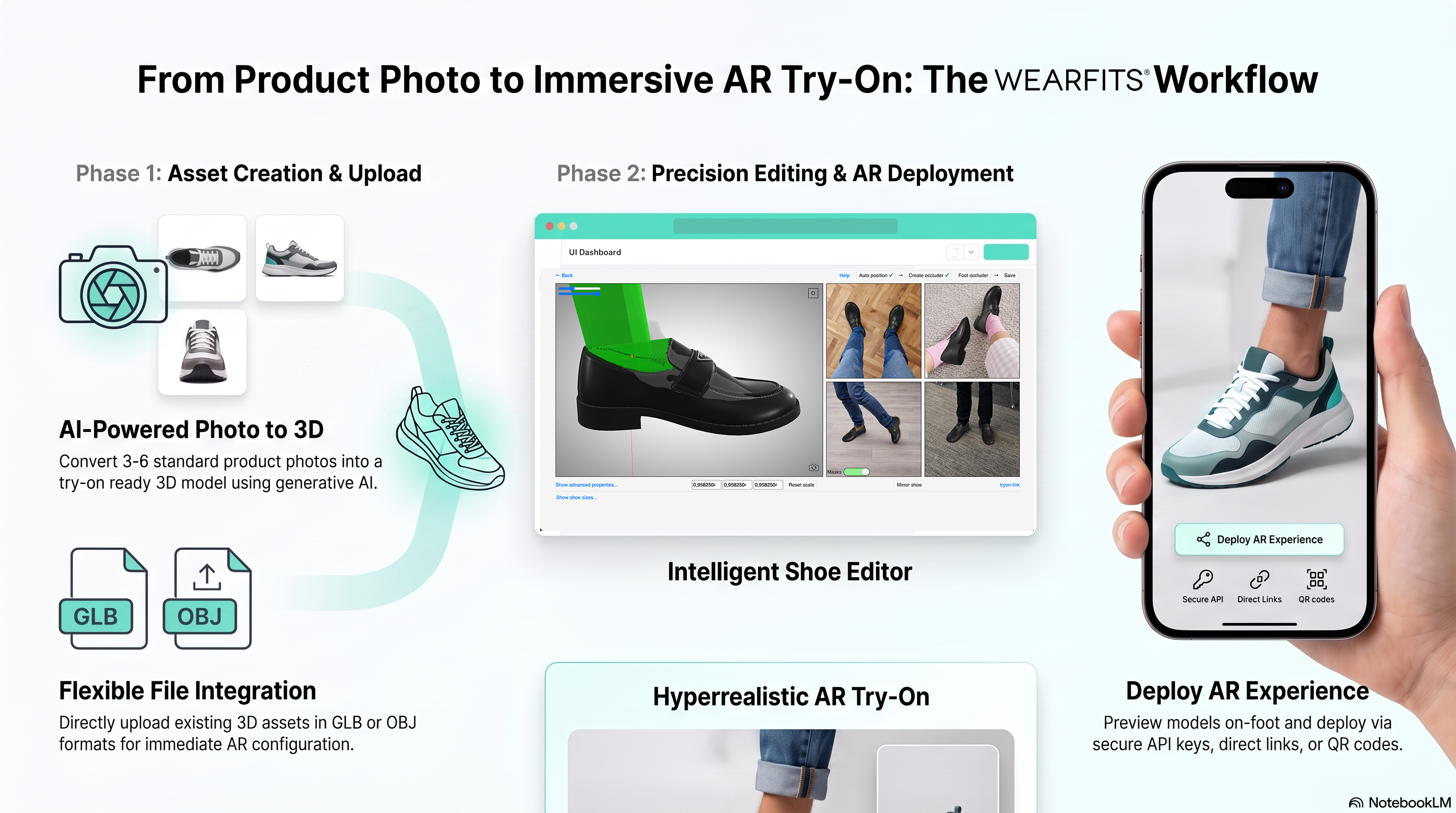
WEARFITS as a modern SaaS platform, can use AI-driven pipelines to generate digital product assets from existing product photography. Instead of requiring every item to be modeled manually, brands can turn standard product images into interactive assets much faster. This makes virtual try-on realistic not only for hero SKUs, but for entire product categories.
For footwear this difference is critical. The commercial value of try-on grows when it is available across the catalog, not only on a few selected products. Customers do not want immersive experiences for just one item. They expect consistency across the shopping journey.
SaaS makes that consistency far easier to achieve.
Custom software does not end at launch. In many cases, launch is only the beginning of the cost curve.
Virtual try-on technology depends on a complex mix of front-end performance, camera access, 3D rendering, browser compatibility, mobile optimization, product data, and sometimes AI-powered fit or feet scanning. The experience must work across devices, screen sizes, browsers, operating systems, and storefront environments.
That complexity creates maintenance debt.
A custom-built solution may require separate workstreams for iOS, Android, desktop, mobile web, and in-store use cases. Each platform may need its own QA cycle, bug fixes, updates, and performance optimization. When Apple, Google, WebKit, Chromium, Shopify, or another platform changes something, the brand or its development partner must react.
For a fashion brand, this is a distraction. The brand’s core business is selling footwear or apparel, not maintaining real-time AR rendering infrastructure.
SaaS shifts that burden to the platform provider.
A web-first SaaS architecture can provide one integration layer that works across the storefront, mobile WebViews, and other digital touchpoints. The SaaS provider maintains the rendering engine, browser compatibility, infrastructure, updates, and performance improvements. When devices, browsers, or technical standards change, the platform evolves with them.
This is one of the most important reasons SaaS try-ons are better than custom-developed solutions. They do not just reduce the cost of building. They reduce the long-term cost of owning and maintaining the technology.
Virtual try-on must feel smooth, realistic, and trustworthy. If it does not, it can damage the shopping experience instead of improving it.
A poor try-on experience creates friction. If a shoe appears in the wrong position, if a garment does not align with the body, if the product looks fake, if the experience loads slowly, or if it fails on mid-range smartphones, customers lose confidence. In fashion e-commerce, trust is everything. The technology must help customers feel more certain, not more confused.
Custom development places this risk on the brand.
The company is paying to discover whether the solution can work well enough. It is financing the development of tracking accuracy, rendering quality, device support, product digitization, and user experience. Even after a working prototype is created, the brand still needs to validate whether it performs at commercial scale.
A specialized SaaS platform reduces that risk because the core technology has already been built, tested, optimized, and improved across real use cases. The provider brings a proven engine, existing workflows, pre-trained models, infrastructure for traffic spikes, and accumulated knowledge from multiple implementations.
This gives brands a faster and safer path to value.
Instead of spending months waiting for a custom build, a brand can launch faster, test performance on product detail pages, measure engagement, track conversion impact, and evaluate return-related outcomes. SaaS makes virtual try-on something that can be tested and improved in market, rather than a large bet made before the brand has any real customer data.
For e-commerce teams, speed matters. A feature that launches in days or weeks is very different from a custom project that takes months.
With custom software, the brand must go through research, planning, design, development, integration, testing, bug fixing, deployment, and maintenance. Even a strong development team needs time to build a reliable try-on experience. The more advanced the feature set, the longer the timeline becomes.
SaaS shortens that path.
A SaaS try-on platform can often be integrated through a plugin, script, API, or e-commerce app. This allows brands to move from decision to deployment much faster. Instead of waiting for a full software development cycle, teams can start using try-on technology directly on product pages and campaigns.
That speed creates a strategic advantage.
The faster a brand launches, the faster it learns. It can see which products generate the most interaction, how customers use the try-on feature, where engagement improves, and whether the experience supports conversion or reduces hesitation. These insights are difficult to get from a custom project still stuck in development.
In other words, SaaS does not only save time. It brings the business closer to real customer behavior.
Realism is one of the most difficult parts of virtual try-on. The experience must look believable enough to support a purchase decision. This is not a simple visual overlay. High-quality try-on may require accurate tracking, smart occlusion, realistic lighting, product masking, spatial positioning, and smooth performance.
For footwear, the system must understand foot position, angle, movement, and scale. For apparel, it may need to represent fit, proportion, body shape, fabric behavior, and visual styling. For accessories, it may need to handle depth, placement, and natural interaction with the body.
These details are difficult to build once and even harder to maintain over time.
Custom software teams can create a version of this experience, but sustained quality requires continuous investment. Every improvement to realism becomes another development task. Every new device or use case introduces more testing. Every product category adds complexity.
WEARFITS as a SaaS platform is better positioned to solve this because our entire product is built around improving the try-on experience. We continuously refine rendering, tracking, asset generation, UX, loading speed, and compatibility. Improvements made for one implementation can strengthen the platform for all clients.
This creates a compounding advantage. The SaaS product gets better over time, while a custom solution risks becoming outdated unless the brand keeps investing in it.
Returns are one of the biggest structural problems in footwear and apparel e-commerce. Customers often buy multiple sizes or colors because they are unsure what will fit or look best. This behavior increases logistics costs, damages margins, complicates inventory planning, and creates unnecessary environmental impact.
Virtual try-on helps reduce uncertainty before purchase.
When shoppers can see a product in a more realistic, personalized context, they can make more confident decisions. For footwear and apparel, this can mean better understanding of size, proportion, color, styling, and fit. When combined with sizing recommendations or body/foot scanning, try-on can move from a visual feature to a decision-support tool.
This is another area where SaaS has an advantage over custom development.
A custom build may focus only on the visual experience. A specialized SaaS platform can combine 3D, AR, product visualization, fit recommendations, analytics, and optimization into one system. That makes it easier for brands to connect the experience to real commercial outcomes, such as conversion rate, engagement, average order value, and return reduction.
The goal is not to add AR because it looks innovative. The goal is to help customers buy with more confidence.
A custom try-on solution is often built for one specific use case: one store, one market, one product category, or one campaign. That can be useful at first, but it creates limitations as the brand grows.
A modern fashion brand needs digital assets and immersive experiences across many touchpoints: product pages, mobile commerce, social campaigns, retail stores, marketplaces, showrooms, and future commerce environments. The same product may need to appear in multiple digital contexts.
This is why the idea of the digital twin is becoming so important.
A digital twin is not just a 3D model. It is a reusable digital version of a product that can power multiple customer experiences. Once created, it can be used for AR try-on, 3D product views, interactive merchandising, virtual showrooms, in-store mirrors, marketing content, and future channels.
SaaS is better suited to this model because it provides infrastructure, not just a one-off feature. It gives brands a scalable way to create, manage, deploy, and update digital product experiences across the catalog.
Custom software can create a specific experience. SaaS can become the operating layer for immersive commerce.
There are cases where custom virtual try-on development may make sense. A large enterprise with a strong internal technology team, unusual data requirements, proprietary hardware, or highly specific UX needs may choose to build its own solution. Some brands may want full ownership of the engine or complete control over every technical layer.
But for most footwear and apparel brands, custom development introduces more complexity than value.
It requires higher upfront investment, longer timelines, specialized technical expertise, ongoing maintenance, infrastructure management, device testing, asset workflows, and continuous improvement. The brand must act like a technology company before it can benefit like a commerce company.
SaaS is usually the more practical path because it gives brands access to advanced technology without forcing them to build and maintain it themselves.
In 2026, immersive commerce is no longer a futuristic experiment. It is becoming part of the expected shopping experience. Customers want more than static images. They want interaction, personalization, transparency, and confidence.
For footwear and apparel brands, 3D and AR SaaS is not just another storefront widget. It is infrastructure for modern product experience.
Compared with custom-developed virtual try-on software, SaaS offers clear advantages:
It launches faster.
It costs less to start.
It scales across more products.
It reduces maintenance burden.
It lowers technical risk.
It improves continuously.
It supports better customer decisions.
It helps brands move from static product pages to interactive digital fitting rooms.
The brands that win in the next era of fashion e-commerce will not be the ones that ask customers to imagine the product. They will be the ones that let customers experience it before they buy.
With a specialized 3D & AR SaaS platform, footwear and apparel brands can transform product pages into immersive shopping experiences without taking on the cost, complexity, and risk of custom software development.
In 2026, SaaS try-on is not simply the easier option. It is the smarter infrastructure choice.