
For years, virtual try-on has been discussed mainly as an e-commerce feature: something added to a product page to compensate for what online shopping cannot provide physically.
That definition is becoming outdated.
The next stage of virtual try-on is not about adding another feature to an online store. It is about building a product experience that can move between the website, smartphone, retail screen and physical store without starting again at every touchpoint.
At the center of this shift is the digital twin.
A fashion product increasingly has two versions: the physical item and its digital representation. The second can be visualized in 3D, placed in augmented reality, connected with sizing information and reused across multiple customer interfaces.
Once this infrastructure exists, the difference between an online fitting room and an in-store AR mirror becomes surprisingly small.
An AR mirror is increasingly a software problem
The term “Magic Mirror” can suggest expensive, specialized hardware. In practice, a modern retail AR installation can be much simpler: a large display, a camera and computing hardware running an interactive experience.
The important part is the software behind the screen.
With a web-first architecture, virtual try-on does not have to be developed independently for every retail format. The same underlying product assets and APIs can support an e-commerce product page, mobile browser, kiosk or digital mirror.
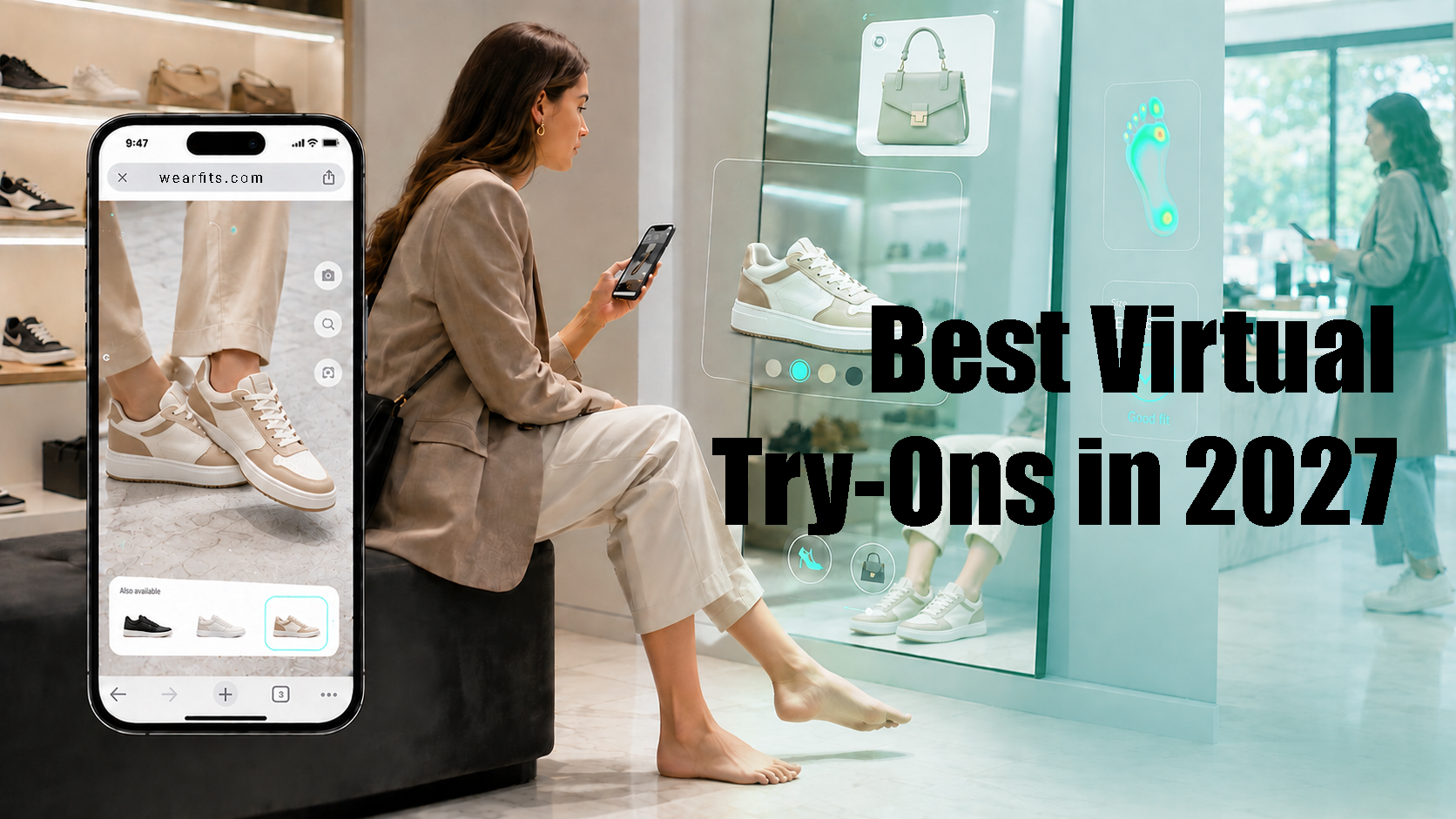
WEARFITS already follows this model. Its virtual try-on experiences operate through the browser without requiring shoppers to download an app, while its API supports reusable digital twins and product digitization workflows. For footwear, standard product photography can also be transformed into 3D assets suitable for AR experiences.
This changes the economics of physical retail experimentation.
Instead of treating an AR mirror as a standalone technology project, retailers can treat the screen as simply another interface to an existing commerce platform.
One product asset, many customer experiences
Historically, interactive 3D commerce had a significant scaling problem: somebody had to create the 3D content.
Producing models manually for a campaign involving ten hero products is manageable. Producing them for thousands of SKUs, seasonal collections and frequent color updates is much harder.
AI-assisted product digitization changes that equation.
When 3D assets can be generated from normal product photography, the digital catalog becomes much easier to expand. The same asset can then support a 3D product viewer, mobile AR, social activation, virtual try-on or an in-store installation.
This is important because the real value of 3D is not a single impressive visualization. It is asset reuse.
A retailer should not need separate content pipelines for the website, app and store. Ideally, there is one product layer underneath all of them.
Update the product once, and every interface can use the new version.
The physical store becomes part of the digital journey
This also changes how we should think about retail screens.
Most digital signage is still essentially television: a sequence of images or videos displayed to everyone in exactly the same way.
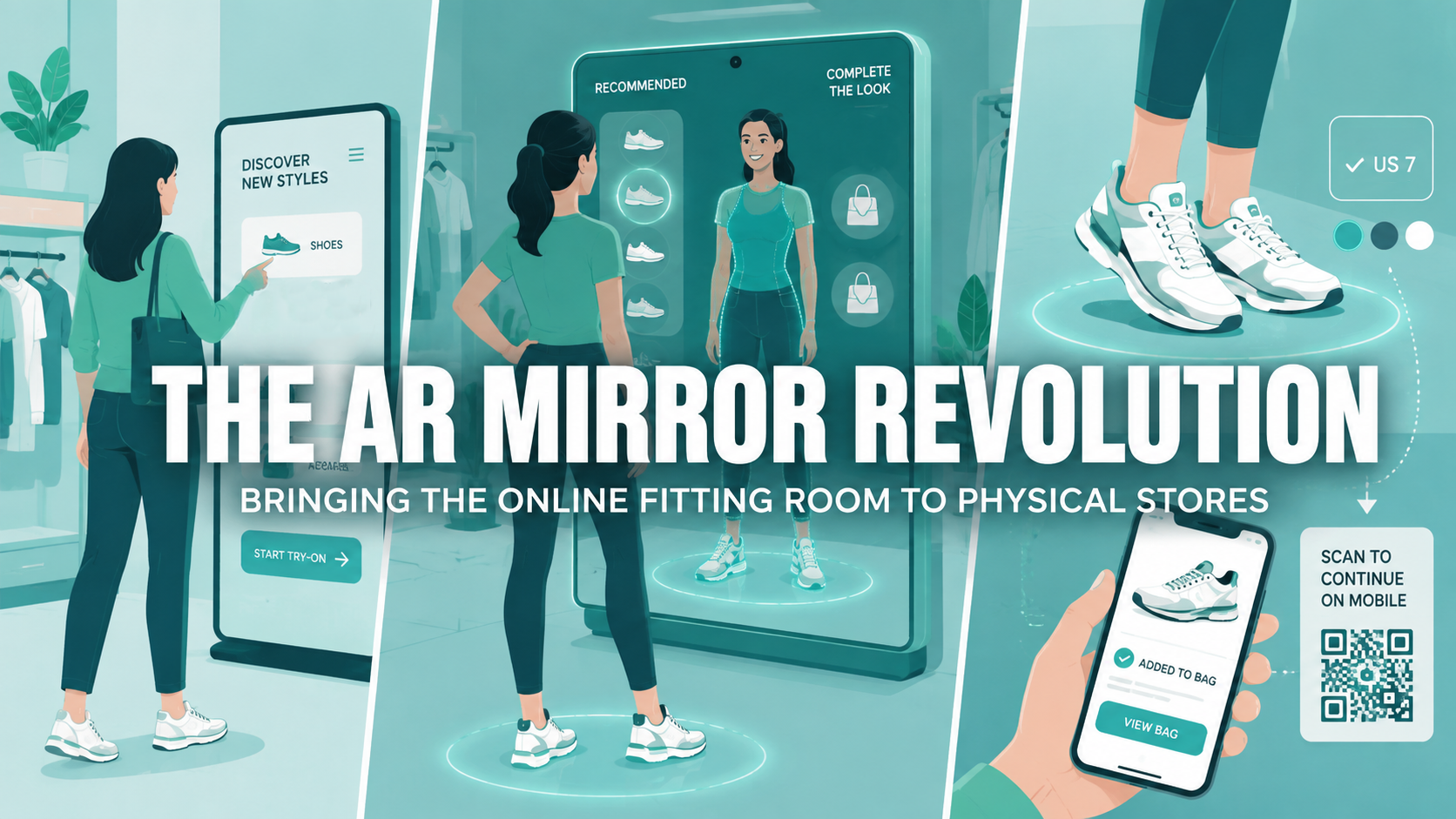
An AR mirror makes the screen interactive.
A customer can explore products that are not physically present, switch colors without finding another pair, compare models, see an item virtually and continue exploring the wider catalog even when the store has limited floor space.
For footwear in particular, this creates an interesting relationship between physical inventory and digital inventory.
The store may stock ten models physically while allowing shoppers to explore fifty digitally. AR does not replace touching or wearing the real product. Instead, it expands the discovery stage before the shopper decides which products are worth trying physically.
That makes the mirror less of a replacement for the fitting room and more of a digital doorway into the complete assortment.
From mirror to smartphone
The most interesting opportunity appears when the interaction does not end at the screen.
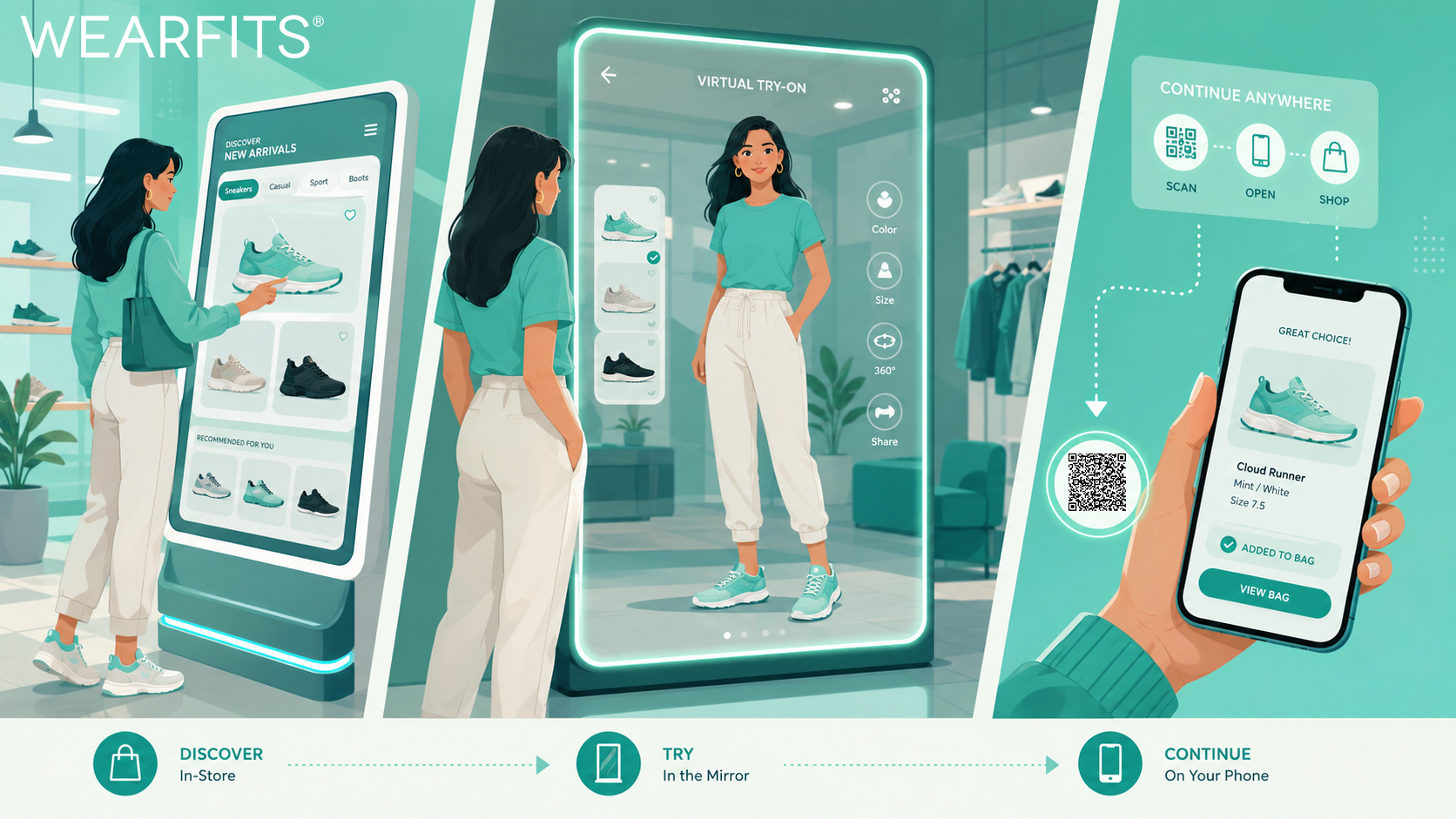
Imagine trying several products on an AR mirror and then scanning a QR code to continue the same session on your phone.
The products you explored can travel with you. From there, you can check availability, save an item, compare another color, continue the AR experience or move toward checkout.
This type of session handoff solves a fundamental problem in omnichannel retail: customers naturally move between surfaces, while retail technology often treats every surface as a new customer journey.
The better model is continuity.
Store → phone → website → purchase should be one connected interaction rather than four isolated sessions.
It also creates better measurement. Interactive retail installations can generate data about products explored, engagement and subsequent digital actions rather than relying only on estimates of how many people passed a screen.
Fit is the next layer
Visualization alone, however, should not be confused with fit.
This distinction is becoming increasingly important in virtual try-on research. Recent work on fit-aware VTO highlights that generating a convincing image of someone wearing a garment and determining whether that garment actually fits correctly are two different technical problems.
For footwear, the same principle applies.
A useful digital fitting experience can combine several layers:
measurement — What are the dimensions of my foot?
size matching — Which size in this specific product is most appropriate?
AR confirmation — What does that choice look like on my foot?
When these layers share the same shopper profile, the experience becomes much more valuable than a visual effect.
Eventually, a customer should not need to repeat the same measurement process every time they move between a retailer's website and physical store. With appropriate consent and privacy controls, their fit profile can travel with them.
From feature to infrastructure
That is why we believe the most important conversation around virtual try-on is changing.
The question is no longer:
“Should we add AR to our website?”
It is:
“How do we create a digital product and fitting layer that works everywhere?”
Once product digitization, virtual fitting, sizing and AR are treated as shared infrastructure, the physical store becomes simply another place where that infrastructure can appear.
A product can begin on Instagram, move to a product page, appear on a shopper's foot through their phone, return on an AR mirror in a store and eventually become a physical purchase.
The interfaces change.
The product data, digital twins and fitting intelligence do not have to.
That is where the AR mirror becomes much more than a futuristic retail display.
It becomes the physical-store interface for the same digital fitting room customers already carry in their pockets.