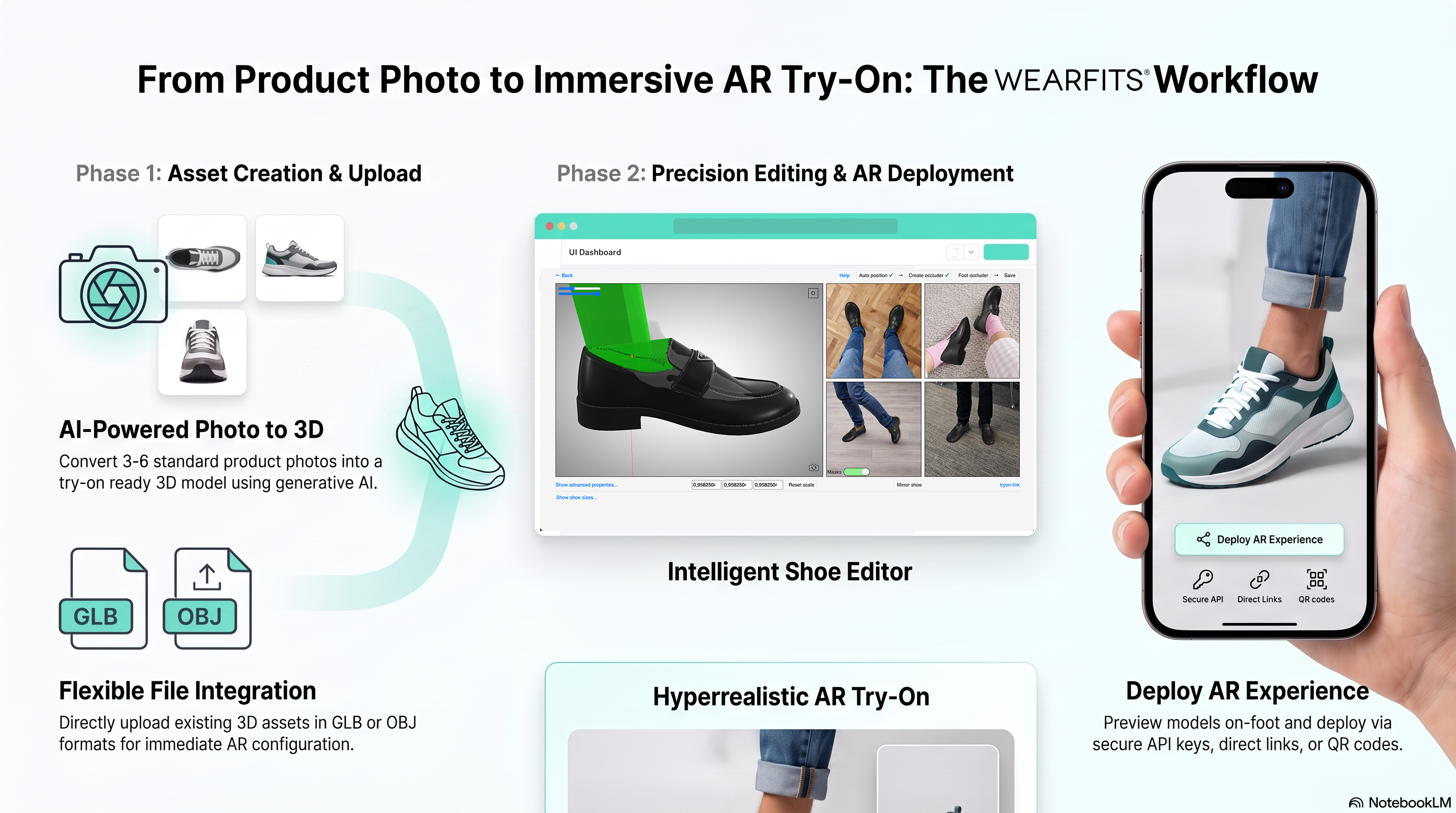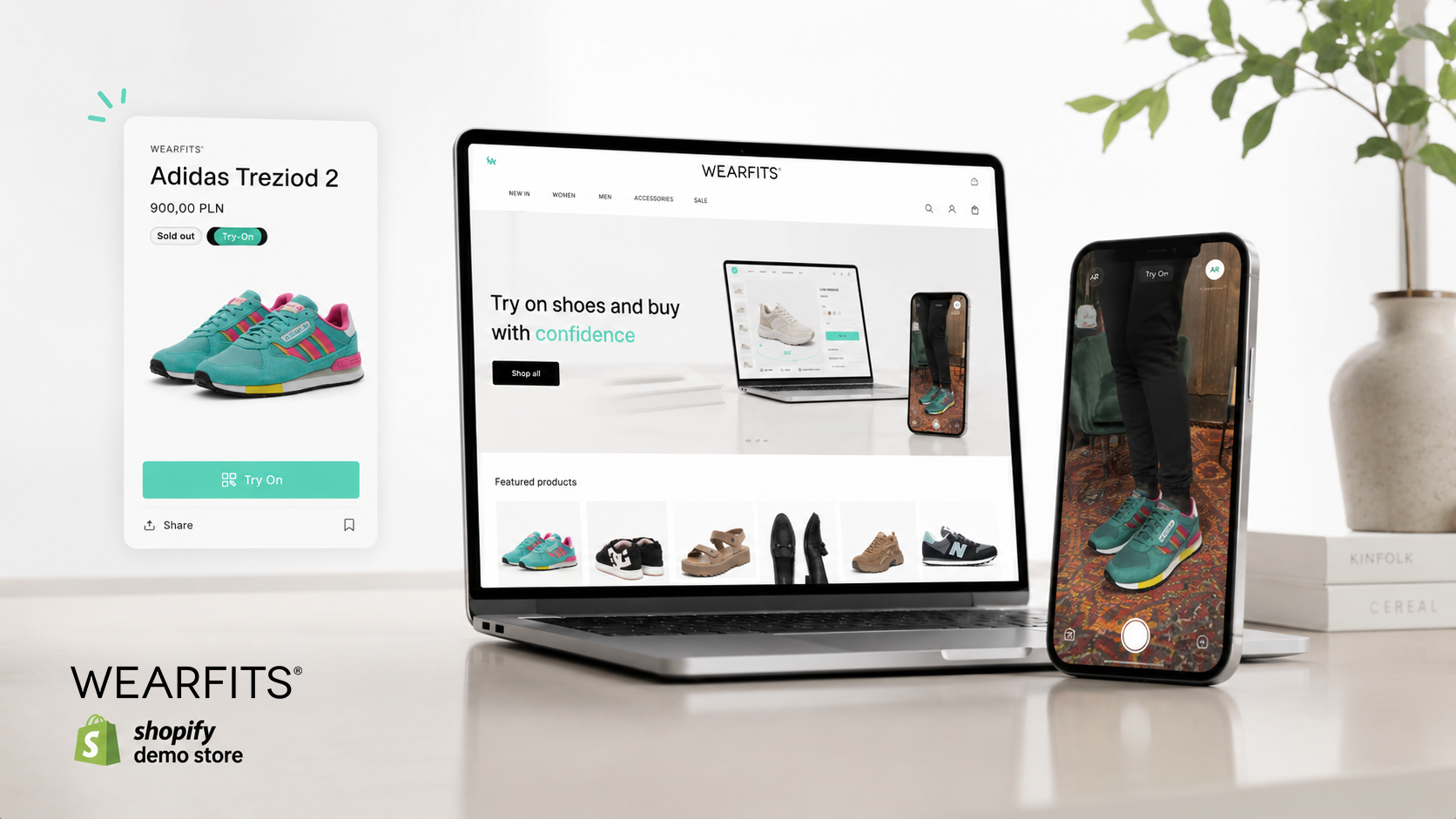
Shopify
AR Try-On
2D-to-3D
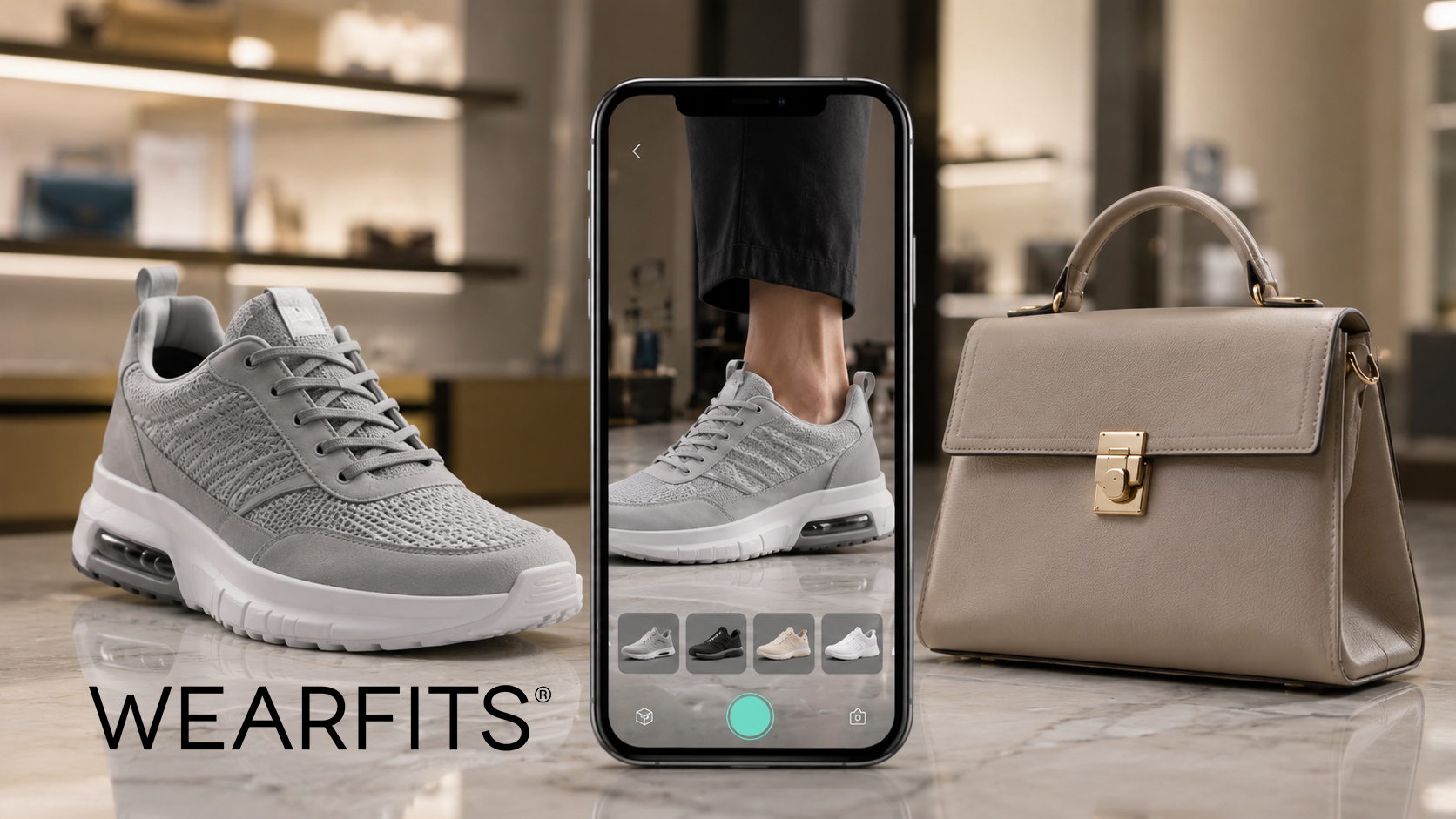

Generative AI has quickly become one of the most talked-about technologies in e-commerce. It is transforming creative workflows, accelerating marketing content production, supporting product ideation, and opening new possibilities for virtual try-on experiences — especially in soft-goods fashion. We do develop generative AI try-on for clothes, yet data shows that for shoes and bags - AR try-ons are better.
Footwear and handbags are not just visual products. They are structured objects with precise proportions, physical dimensions, material details, and brand-defining elements. A shoe must follow the shape of the foot. A handbag must keep its real size in relation to the body. A buckle, logo, seam, leather texture, or silhouette cannot be approximate — it has to be accurate.
At WEARFITS, we work at the intersection of 3D, AR, fashion, and e-commerce. We recognize the value of generative AI and its potential in many areas of digital commerce. However, when it comes to footwear and accessories, we believe that Augmented Reality based on accurate 3D models remains the most reliable, scalable, and commercially effective technology for virtual try-on.
In this article, we explain why AR continues to outperform generative AI in footwear and accessories — from product fidelity and real-time user experience to privacy, scalability, cost efficiency, and business impact.
The fundamental difference between AR and generative AI lies in how the final image is created.
In WEARFITS AR solutions, the customer interacts with a digital twin of the real product. This is not an AI-generated visual interpretation or a stylized approximation. It is a precise 3D representation of the physical item, designed to reflect its actual geometry, proportions, surface structure, materials, and behavior under light through PBR — Physically Based Rendering.
This means the customer sees the product as it truly is. Every stitch, perforation, buckle, logo detail, leather grain, sole shape, seam, and construction element appears in the correct place.
Generative AI try-on works differently. Instead of placing a verified product model onto the user’s body or environment, it generates a new image pixel by pixel. The result may be visually impressive, but it is based on probability rather than physical accuracy.
For footwear and accessories, this distinction is critical.
A generative model can subtly change the shape of a buckle, distort a logo, modify the color tone, shift the stitching line, smooth out the texture, or adjust the product to better match the lighting and composition of the uploaded image. The output may look attractive, but it may no longer be fully faithful to the actual product.
For customers buying premium shoes or handbags, details matter. Virtual try-on should not only inspire. It should help customers verify what they are about to buy.
AR gives users a realistic, product-accurate experience. Generative AI often gives them a beautiful image — but not always a reliable one.
Shoes and handbags are experienced in motion. Customers do not want to see them only in one static pose. They want to move, rotate, compare angles, check proportions, and understand how the product works with their body and style.
This is where AR has a major advantage.
A WEARFITS AR try-on experience works live through the smartphone camera. Advanced tracking algorithms analyze movement in real time and map the digital product onto the user’s foot or body smoothly and naturally.
A customer can move their leg, rotate their foot, change perspective, lift the shoe, or view it from different angles — and the digital product follows instantly. This creates a more immersive experience and helps build psychological ownership before purchase.
Generative AI try-on experiences are usually static. The customer uploads an image, waits for the system to process it, and receives a single generated picture. If they want to see another angle, they need to repeat the whole process: take another photo, upload it again, wait for a new result, and evaluate another static output.
In mobile commerce, every extra step creates friction. And friction reduces engagement.
AR removes that friction. It gives customers an immediate, interactive experience that feels much closer to trying the product in real life.
One of the biggest challenges in online accessory shopping is helping customers understand the real size of a product.
Will this shopper bag fit a laptop?
Will this crossbody bag look too small?
Will this handbag overwhelm my silhouette?
Is this bag practical for everyday use?
These questions often stop customers from completing a purchase.
AR solves this problem by preserving true-to-life scale. A 3D handbag model includes real metric dimensions, so when customers view it on their shoulder, next to their body, or in their space, they see the product in accurate proportions.
This is especially important for handbags, where size perception is one of the key decision-making factors. A few centimeters can change how useful, elegant, or comfortable a bag feels.
Generative AI does not operate with the same strict spatial logic. Its goal is usually to create a visually coherent and aesthetically pleasing image. If the model decides that a smaller or larger version of the bag looks better in the generated composition, it may adjust the product scale without the user knowing.
This can create a gap between expectation and reality. A customer may receive a product that feels noticeably different in size from the image they saw before purchase.
For accessories, accurate scale is not a nice-to-have. It is essential.
Human hands and feet remain difficult for generative AI models. Their anatomy is complex, highly variable, and constantly changing depending on posture, movement, camera angle, and perspective.
In footwear try-on, this becomes especially important.
Generative AI can struggle to integrate the foot naturally with the shoe. It may create unnatural edges, merge toes into the upper, distort the ankle area, change the foot shape, or produce artifacts that immediately make the image feel wrong.
Even small anatomical errors can reduce trust. Customers may not consciously analyze the technical reason, but they will notice that something looks unnatural.
WEARFITS AR solutions use specialized tracking systems designed for body-part detection and alignment. Instead of recreating the user’s anatomy from scratch, AR works with the real camera image and places the 3D product in the correct position.
The system respects the user’s actual foot position, movement, outline, and perspective. The result is more stable, more accurate, and more believable.
For footwear, this difference matters. A virtual shoe should not look like it has been generated around the body. It should look like it is naturally placed on the foot.
Every e-commerce technology must respect how customers actually behave.
Generative AI try-on tools often require users to take and upload a photo of themselves. In many cases, they need to stand in a specific pose, wear certain clothing, or prepare an image that allows the AI model to identify the body correctly.
This creates one major barrier.
Effort. Taking the right photo, uploading it, waiting for processing, and repeating the process for different angles adds time and complexity to the shopping journey.
WEARFITS AR works differently. The experience happens instantly through the smartphone camera. Customers simply point their phone at their feet or body and see the product in AR.
The process is fast, intuitive, and privacy-friendly. It does not require users to upload personal photos or wait for a generated result. The shopping journey remains smooth from discovery to decision.
In a world where mobile shoppers expect immediate experiences, this simplicity is a major advantage.
Another important difference between AR try-on and generative AI try-on is where the computation happens — and how much it costs to scale.
Generative AI try-on typically relies on cloud infrastructure. Each time a customer uploads a photo and requests a new generated image, the system needs server-side processing power. This means GPU usage, cloud storage, data transfer, queue management, and repeated rendering costs.
For a single demo, this may seem manageable. But at e-commerce scale, where thousands or millions of users may want to try multiple products, colors, poses, and perspectives, the cost can grow quickly.
Every new generated image creates an additional compute expense. Every new perspective means another server request. Every traffic peak increases infrastructure pressure. As a result, generative AI try-on can become expensive to operate, especially for brands with large product catalogs and high mobile traffic.
AR try-on follows a different model.
WEARFITS AR experiences are powered directly on the user’s smartphone. The product is represented as an optimized 3D model, while real-time tracking, rendering, and interaction happen locally on the device.
This significantly reduces the need for costly cloud-based computation during the customer session. Once the 3D asset is created and integrated, the try-on experience can be delivered repeatedly without generating a new image on a remote server each time.
The user’s device does the heavy lifting.
This makes AR not only faster and more private, but also much more cost-efficient at scale.
Generative AI may appear inexpensive when looking at a single generated image. However, operational costs increase with every interaction. AR requires an initial investment in high-quality 3D assets, but those assets can be reused across thousands or even millions of sessions with minimal incremental cost.
For brands and retailers, this distinction is crucial. AR offers a more sustainable cost structure for large-scale virtual try-on, combining real-time performance, lower operating costs, and long-term asset value.
| Feature | AR Try-On by WEARFITS | Generative AI Try-On |
|---|---|---|
| Product representation | Accurate 3D digital twin with real geometry, proportions, and PBR materials | Pixel-generated image with a risk of visual distortion or hallucinated details |
| Product fidelity | Preserves stitches, logos, materials, buckles, seams, and construction details | May alter details to create a visually coherent image |
| Response time | Real-time interaction with smooth motion tracking | Waiting time required for each generated image |
| Movement | Live, interactive experience that follows the user’s motion | Static output; each new angle requires a new generation |
| Scale and proportion | True-to-life metric scale, especially important for handbags | No guaranteed fixed scale; image may be optimized for aesthetics |
| Anatomy handling | Dedicated tracking for feet, hands, and body positioning | Frequent challenges with hands, feet, and natural alignment |
| Computation | Runs locally on the user’s smartphone | Processed in the cloud using server-side compute |
| Operating cost | Low incremental cost per try-on session after 3D asset creation | Recurring GPU/server cost for every generated image |
| Asset value | One 3D model can be reused across AR, 3D viewers, product pages, campaigns, and virtual showrooms | Each new view usually requires a separate generated output |
For e-commerce leaders, the most important question is not whether a technology is exciting. The question is whether it improves business performance.
Generative AI can be useful for fast visual ideation, creative production, moodboards, campaign concepts, and personalization. However, when it comes to structured products such as footwear and handbags, it does not fully solve one of fashion e-commerce’s biggest challenges: product uncertainty.
If customers cannot trust the scale, shape, color, and details of what they see, they still buy with hesitation. That uncertainty can lead to disappointment, lower satisfaction, and higher return rates.
WEARFITS AR solutions are designed to reduce that uncertainty. By showing customers an accurate, interactive, true-to-scale representation of the product, AR supports more confident purchasing decisions.
For brands and retailers, this can translate into meaningful business benefits: stronger engagement, higher conversion, lower return rates, and better use of digital assets.
The cost model also matters.
Generative AI try-on often creates a recurring cost for every interaction, because each output must be processed in the cloud. AR, by contrast, shifts the experience to the user’s device. Once the 3D asset is prepared, it can be reused across product pages, AR try-on, marketing campaigns, virtual showrooms, sales tools, and future immersive commerce environments without requiring a new cloud-rendered image every time.
This makes AR a more scalable and cost-efficient solution for brands with large catalogs, high traffic, and long-term digital commerce strategies.
A high-quality 3D model is not a one-time visual. It is a reusable digital asset. It can support multiple channels and customer touchpoints over time, creating value far beyond a single try-on session.
In this sense, 3D and AR are not only customer experience tools. They are part of a broader digital infrastructure for modern fashion commerce.
At WEARFITS, we believe the future of e-commerce will be shaped by smart combinations of technologies. Generative AI has an important role to play in trend exploration, creative content production, personalization, recommendation systems, and certain types of fashion visualization.
But in footwear and handbags — where structure, proportion, detail, and physical accuracy define the customer experience — Augmented Reality remains unmatched.
AR gives customers what generative AI still cannot reliably provide: true-to-life scale, real-time interaction, product fidelity, privacy, and a frictionless shopping journey.
It also gives brands a more efficient operating model. Instead of generating each try-on view in the cloud at a recurring cost, AR uses optimized 3D assets that run directly on the user’s smartphone and can be reused across multiple channels.
For brands, investing in AR is not about following a technology trend. It is about building a more trustworthy, scalable, and responsible e-commerce experience — one that helps customers buy with confidence and helps businesses grow with greater efficiency.
In the world of footwear and accessories, accuracy is not optional. It is the foundation of trust.
And that is why AR still leads the way.