Shopify
AR Try-On
2D-to-3D

For years, product imagery has been one of the most expensive, slow-moving parts of e-commerce.
Every new collection creates the same operational pressure: samples need to arrive, shoots need to be scheduled, photographers and stylists need to be booked, images need to be edited, variants need to be covered, campaign assets need to be resized, and product pages need to be updated before launch.
For small teams, this process is exhausting. For larger brands, it becomes a serious cost center.
The problem is not that product imagery is unimportant. It is the opposite. In online shopping, imagery carries much of the burden that physical retail handles naturally. A customer cannot pick up the product, rotate it, compare its scale, see how it looks in real life, or try it on. The product page has to do all of that work through visuals.
But the traditional content model was built for a static version of e-commerce. It assumes that the final output is a set of flat images: front view, side view, detail shot, lifestyle shot, maybe a video. Once those assets are created, they are uploaded, cropped, distributed, and eventually replaced by the next shoot.
Leading brands are starting to move differently. Instead of treating product photos as the final asset, they treat them as the input for something more scalable: a reusable 3D product system.
That is the core of the 3D-first strategy.
A 3D-first strategy does not mean abandoning photography. It does not mean every brand needs a large 3D team, a scanning studio, or a complex CGI pipeline.
It means the product is digitized early enough that 3D becomes the foundation for multiple visual outputs.
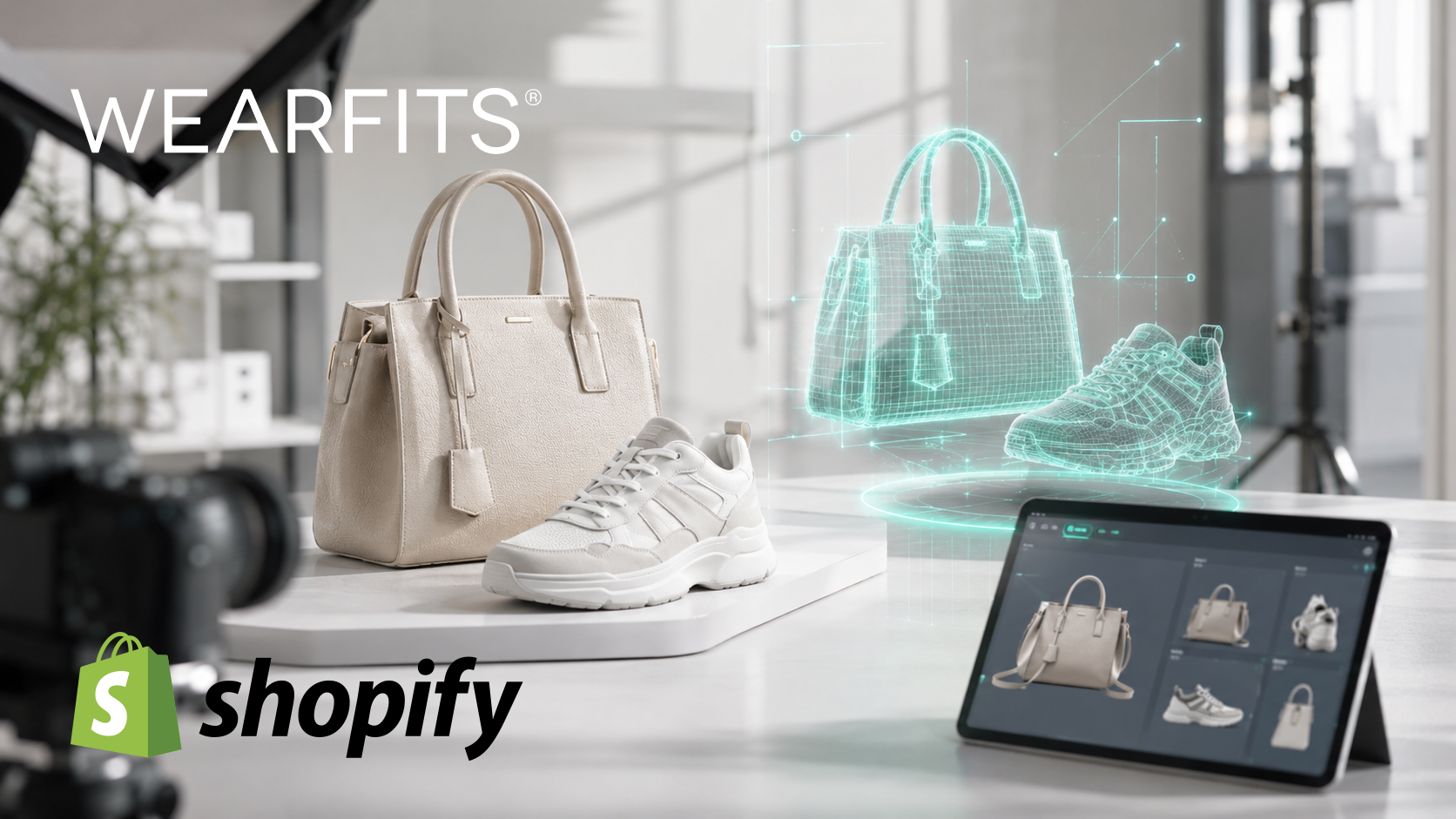
In a traditional workflow, a brand creates product images and uses them once: on a product page, in a campaign, in an ad, or in a lookbook. In a 3D-first workflow, the brand uses product photography to generate a digital twin. That digital twin can then support product pages, virtual try-on, AR experiences, interactive viewers, campaign content, social assets, and future commerce channels.
The difference is structural.
Static imagery is a finished file. A 3D asset is a reusable product layer.
Once a product exists as a high-quality digital twin, the brand is no longer starting from zero every time it needs a new angle, a new channel, or a more interactive customer experience.
The traditional product imagery workflow scales badly because almost every step grows with SKU count.
If a brand has 20 products, the shoot may be manageable. If it has 200 products, the same workflow becomes heavy. If every product comes in multiple colors, materials, heights, shapes, and seasonal variations, the visual workload grows even faster.
That workload creates costs in several places.
First, there is production cost. Studio time, photographers, assistants, models, retouching, styling, logistics, and sample handling all add up.
Second, there is the time cost. Content production often becomes a bottleneck between product development and launch. Even when products are ready to sell, the store cannot fully launch them until imagery is complete.
Third, there is duplication. Many brands maintain one workflow for e-commerce photography, another for campaigns, another for 3D assets, another for social, and another for retail activations. Each workflow has its own briefs, files, vendors, reviews, and delays.
Fourth, there is inconsistency. When different teams create different visual assets from different source materials, the customer experience can feel fragmented. The product looks one way on the PDP, another way in an ad, another way in a marketplace listing, and another way in an AR experience.
The bigger the catalog, the more expensive this fragmentation becomes.
The 3D-first model changes the role of product photography.
Instead of asking, “What images do we need for this product page?” the brand asks, “What source assets do we need to power every visual experience for this product?”
That shift saves time because the same product capture can support more outputs. Clean product photos from multiple angles can become the basis for a digital twin. Once that digital twin exists, it can be used across the shopping journey.
A shoe can appear as a product-page image, an interactive 3D model, a virtual try-on experience, a product-listing badge, a social campaign asset, and an in-store AR activation. A bag can move from a static listing to a shopper’s real environment through AR or a try-on. A backpack can be visualized from multiple perspectives without requiring a new studio setup for every context.
The product is no longer locked inside one photo set.
It becomes flexible.
This is where the savings become practical. Brands reduce the need to recreate assets for every channel. They reduce the dependency on repeated studio work. They reduce delays caused by separate 3D production. And they create a visual foundation that can keep serving the business after the launch campaign ends.
Speed matters in modern commerce.
Fashion, footwear, and accessories brands are under pressure to launch faster, test more collections, react to demand, and refresh product pages without waiting weeks for new assets. A slow imagery workflow creates friction across the entire business.
A 3D-first strategy helps because it fits into the production pipeline brands already use.
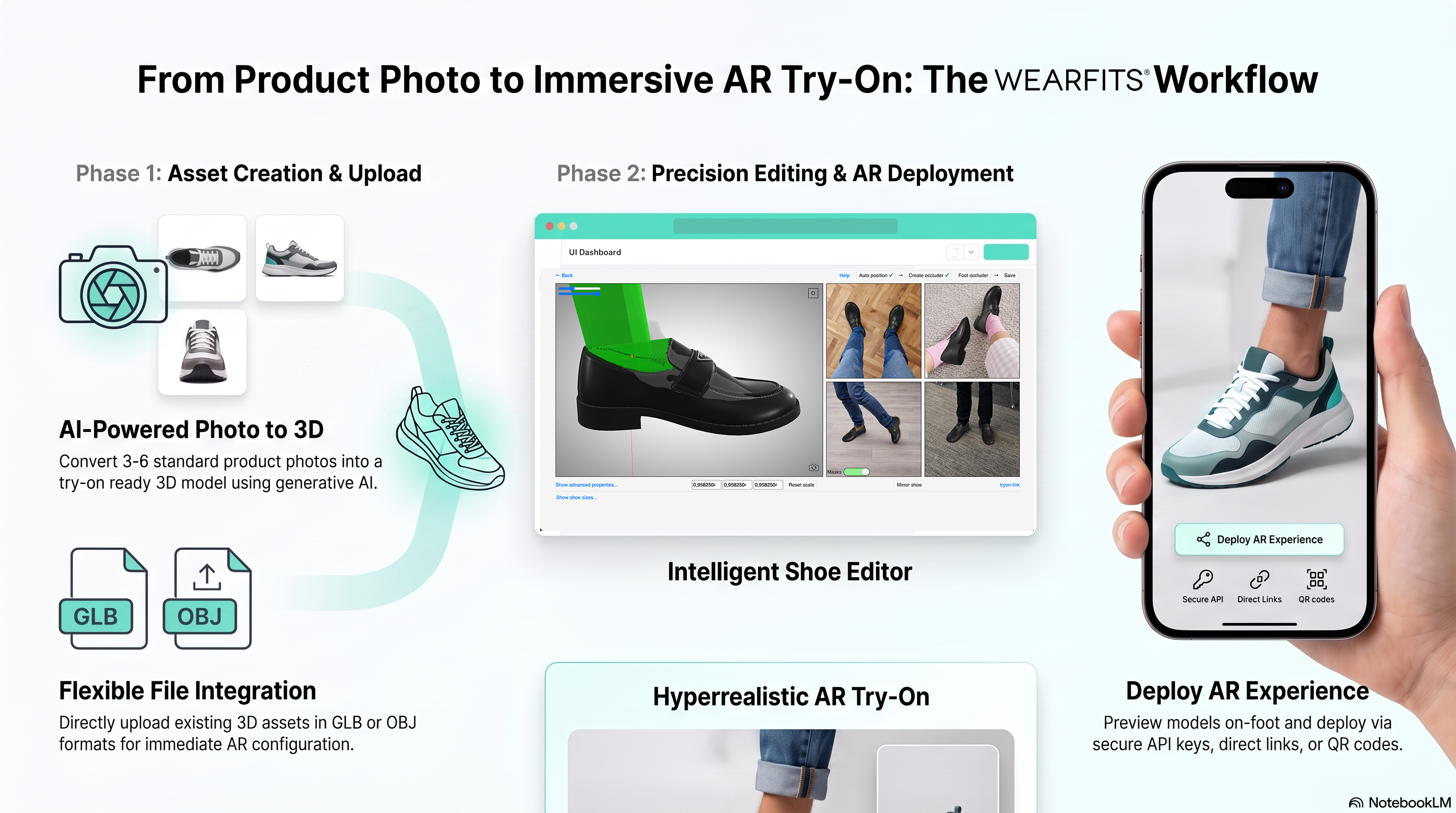
With WEARFITS, brands can use standard product photography as the starting point. Instead of requiring CAD files, specialized scanning, or manual 3D modeling for every SKU, the system generates 3D assets from product images. For Shopify merchants, the process is designed to be simple: install the app, upload product photos, generate 3D assets, and activate the try-on experience on selected product pages.
That means teams do not need to rebuild their content workflow from scratch.
The same images prepared for e-commerce can now support interactive visualization. A product shoot is no longer just a shoot. It becomes the first step in building a scalable digital asset library.
The economic benefit becomes strongest when brands think beyond hero products.
Many brands start with 3D or AR as a campaign feature. They digitize a few bestsellers, create a polished launch moment, and leave the rest of the catalog static. That can be useful, but it misses the bigger opportunity.
The real value of 3D-first is full-catalog coverage.
Traditional 3D production has often been too expensive to apply across hundreds or thousands of SKUs. Manual modeling, specialist vendors, review cycles, and asset preparation made 3D feel like an enterprise-only tool. Most brands could justify it only for their highest-value products.
AI-powered photo-to-3D changes that equation. When standard product images can become usable digital assets, 3D production becomes part of the normal catalog workflow rather than a separate innovation project.
That matters because customers do not browse only hero SKUs. They compare colors, silhouettes, sizes, and similar products. If only one product in a category is interactive, the experience feels inconsistent. If the entire category is interactive, the store feels modern, complete, and easier to shop.
Full-catalog 3D also improves internal efficiency. Teams can plan one standardized capture process, generate assets consistently, and reuse them across storefront, mobile, campaign, and retail touchpoints.
The strongest brands do not treat 3D as a visual upgrade only. They treat it as a performance layer.
Better product visualization affects customer behavior because it reduces uncertainty. A static product image can show what an item looks like. A 3D or AR experience can show how it looks in context.
For footwear and accessories, that context is critical. Shoppers want to understand scale, proportion, styling, and appearance before they buy. A shoe on a white background may look good. A shoe on the customer’s own foot creates a different level of confidence. A bag in a studio image may look elegant. A bag seen on the body helps the shopper understand whether it fits their style and proportions.
This is where product imagery connects directly to conversion and returns.
When shoppers understand products more clearly, they make faster and more confident decisions. When expectations are closer to reality, the risk of disappointment decreases. The visual asset is no longer just supporting the brand image. It is supporting the economics of the store.
A 3D-first strategy only works if the output feels credible.
Low-quality 3D can do more harm than good. If scale is wrong, lighting feels artificial, or the product does not align naturally with the shopper’s body, the experience becomes a gimmick instead of a buying tool.
That is why realism matters.
At WEARFITS, the goal is not simply to create a 3D object. The goal is to create a product experience customers can trust. That requires accurate scaling, natural alignment, smart occlusion, dynamic lighting, and lightweight performance for mobile use.
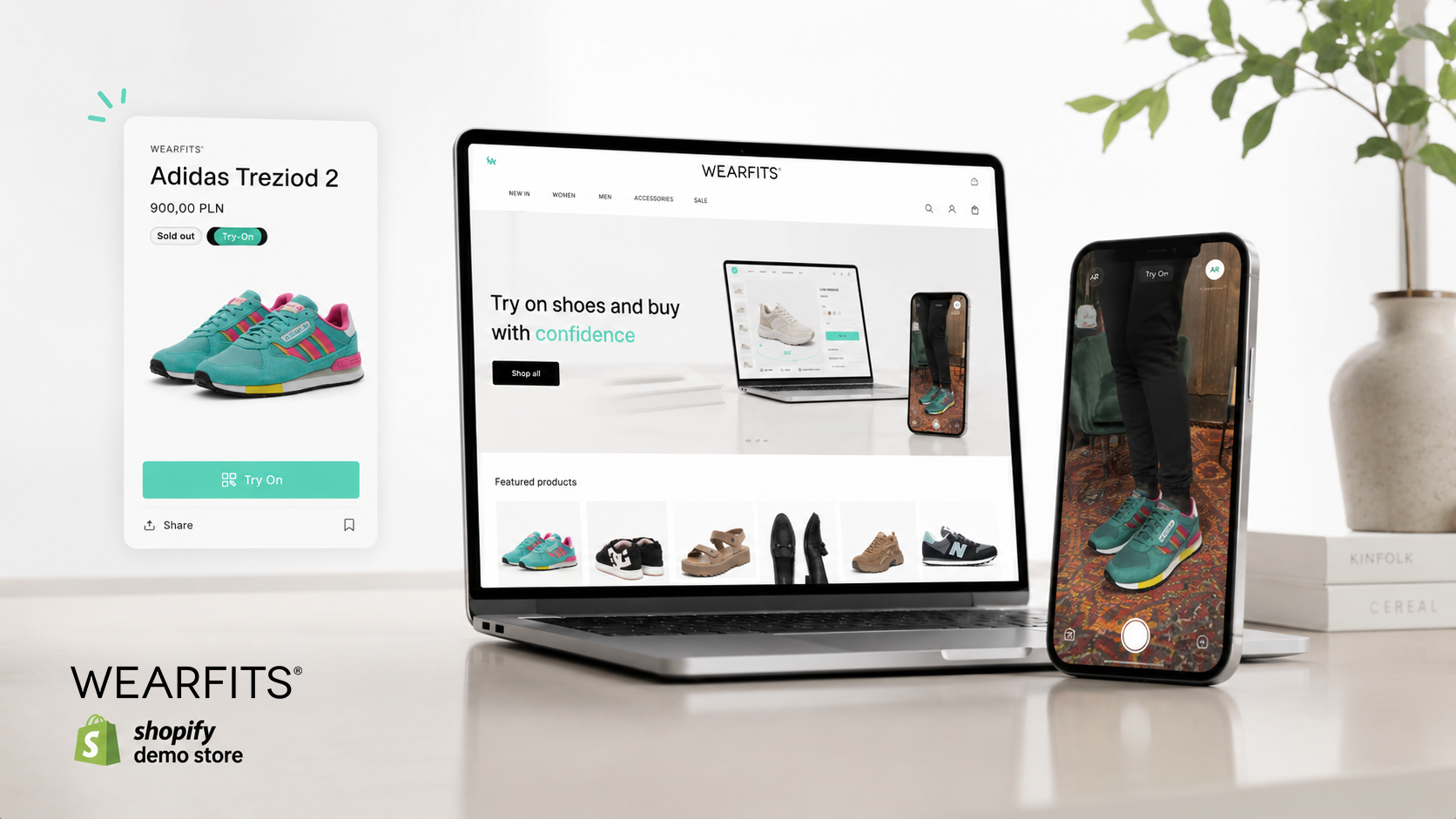
For Shopify merchants, the customer experience needs to feel instant and natural. A shopper should be able to tap “Try On,” use the phone camera, and understand the product more clearly within seconds. The experience should reduce friction, not add another layer of complexity.
This is the difference between 3D as a novelty and 3D as infrastructure.
The transition does not need to happen all at once. The most practical approach is to turn 3D-first into a repeatable workflow.
Start by auditing the catalog. Identify the products where better visualization would have the highest impact: bestsellers, high-return items, new launches, products with strong visual differentiation, and SKUs where scale or styling is hard to communicate through photos alone.
Next, standardize photography. Clean product angles, consistent lighting, neutral or white backgrounds, and high-resolution images make 3D generation more reliable. The goal is not to make the shoot more complicated. The goal is to make it more useful.
Then generate digital twins from those images. Once assets exist, connect them to the product page, activate try-on where relevant, and make the experience visible to shoppers. The “Try On” button should not be hidden. If the product is interactive, the store should make that obvious.
Finally, measure the business impact. Track engagement, product-page conversion, add-to-cart behavior, return reasons, and performance across products with and without interactive visualization. The point is not to adopt 3D because it looks advanced. The point is to prove where it saves time, cuts cost, and improves the shopping journey.
The brands that get the least value from 3D are usually the ones that treat it as a marketing stunt.
They create a few impressive assets, launch a campaign, and then return to the same slow imagery workflow they had before. The result is a nice moment, but no structural change.
The brands that get the most value treat 3D as a content system.
Every new product enters the same pipeline. Every photo shoot is planned with digitization in mind. Every digital twin becomes part of a reusable asset library. Every product page becomes more interactive. Every channel can pull from the same visual foundation.
That is the real 3D-first strategy.
It is not about replacing the creative team. It is about giving the creative, e-commerce, and product teams a better foundation to work from.
E-commerce is moving from static product presentation to interactive product experience.
Customers increasingly expect to explore products, understand them, and see them in context before buying. Product imagery will still matter, but the definition of “imagery” is expanding. It is no longer just a gallery. It is a 3D model, an AR try-on, a product viewer, a campaign asset, a retail experience, and a reusable digital twin.
For brands, this is a chance to rethink one of the most expensive parts of selling online.
Instead of producing more and more static assets for every new campaign, leading teams are building a visual infrastructure that compounds. They capture once, digitize once, and reuse across the full customer journey.
That saves time. It reduces production waste. It speeds up launches. It improves product pages. It gives shoppers more confidence. And it turns product imagery from a recurring cost into a scalable advantage.
At WEARFITS, we believe every product will eventually have a digital twin. For Shopify brands selling shoes, bags, backpacks, and accessories, that future is no longer far away. It can start with the product photos you already have.
The brands that move first will not just have better visuals.
They will have a faster, leaner, more interactive way to sell.