Shopify
AR Try-On
2D-to-3D

TL;DR. Sizing is the single largest unprofitable cost line in online footwear. Industry data puts apparel and footwear return rates at 22% of orders, and inside those returns roughly three out of four are size-related. AR try-on on its own — the kind that drops a shoe onto your foot in the browser — looks beautiful but moves a different set of metrics. The lever that shifts P&L is a virtual fitting that combines two things in one view: a realistic AR rendering of the shoe on the shopper's actual foot, and an AI-predicted fit verdict for that exact size in that exact last. WEARFITS Virtual Try-On & Sizing is the first virtual try-on solution to render a realistic AR shoe on a shopper's foot AND tell them if it fits — in one view, one flow, one tap. Around 20% returns reduction. Around 30% conversion lift. 99% measurement accuracy from a 60-second phone scan, remembered forever.
Five years in, after hundreds of calls with footwear merchants, e-com directors and supply-chain leads, we kept hearing the same thing in slightly different words.
"We love what the AR try-on is doing for engagement. Our CFO loves the returns numbers. Now she wants more."
That sentence is the reason this article exists. CFOs in footwear have already seen the first wave of returns reduction — the cleanup that came from better imagery, better size guides, and basic AR try-on. They want the next wave. And the next wave is not "more AR." It is closing the size question inside the same view as the AR render.
This is the long version of what we learned along the way — the numbers, the merchant stories, the technical choices, and the playbook for getting AR try-on and AI fit prediction to behave like one feature instead of two.
WEARFITS is an AI-powered virtual try-on platform for footwear, bags, and apparel — web-first, no app download, deployable on Shopify, mobile WebViews, and in-store mirrors from one integration.
Returns in fashion are usually framed as "people change their minds." That framing is wrong for footwear specifically, and it has misled product roadmaps at almost every brand we have spoken with.
Apparel and footwear sit at the top of the e-commerce returns league table. Happy Returns' 2025 industry analysis put the category return rate at 22% — the highest of any retail vertical that year. Statista Consumer Insights for 2024–2025, surveying nearly 10,000 U.S. adults, reported that 17% of all shoe purchases come back, second only to clothing at 25%. Returnalyze's 2025 Peak-Season Report shows women's shoes running at around 29–30% in peak season.
And the part that matters. Kiwi Sizing's analysis of Shopify return reasons found that around 75% of online clothing returns involve an item not fitting. Fittingbox's footwear benchmarks confirm the same picture for shoes: the dominant return reason, by a wide margin, is "too small" or "too big," not "looks different than the photo."
If your footwear catalogue runs a 25% return rate, roughly 18 of every 100 pairs come back because of size, not style. That is the P&L line your CFO is asking you to move next.
Three structural reasons, all confirmed by what merchants told us. Shoe sizes are not standardised across brands — a women's US 8 in one brand can be a 7.5 in another, with up to 10 mm of interior length variation as documented by Road Runner Sports. Last shape matters more than size number — a court last and a running last in the same labelled size fit completely differently. And shoppers do not read size charts — under 15% open them before buying, a number echoed in the Shopify Community sizing thread.
When all three stack, the result is bracketing — ordering two or three sizes and returning what does not fit. Every parcel out is two parcels back. Fixing footwear returns means fixing the moment of size selection, not the moment after the parcel arrives.
AR try-on for shoes has had two distinct lives.
The first wave, 2019–2023, was brand and engagement-led. Snap filters, hero campaigns, a "try in AR" button on the PDP. It worked for what it was: more time on page, social shares, brand lift. The returns line moved a little because shoppers had a better look at the shoe before buying.
The second wave — the one we are in now — treats AR try-on as a returns lever as much as a brand one. The metric your CFO already cares about is contribution margin per pair shipped. AR alone has already taken a first bite out of size-related returns by giving shoppers more confidence in the visual. The question is what takes the next bite.
Beautiful AR with no fit verdict moves engagement. AI fit prediction with no visual moves trust. Combined in one view, they move the returns line again.
The shopper conversations we ran made this clear. A standalone AR view kept testers on the page longer but did not change the size they picked — they bought their usual number. A standalone size predictor that returned "you are a 42" with no visual was trusted by fewer than half of testers. The combined view — AR rendering plus a fit verdict, in the same frame — changed the size shoppers actually selected, and the "try a half size up just in case" instinct quietly disappeared.
That combined view is what we shipped, and it is the reason this whole article exists.
When merchants ask us "what is the best virtual try-on for shoes," the honest answer is that the question only makes sense once you decide which problem you are buying for. A try-on that wins a creative award is not the same as a try-on that takes the second bite out of returns. After hundreds of merchant calls, we ended up with six criteria that consistently separate a virtual shoe try-on that earns its keep from one that does not. Quality, performance, realism, scalability, cost efficiency, and sizing. Each is what a 2026-era VTO platform has to clear to be the best virtual try-on for shoes.
The most common reason a try-on stalls in production is silent quality drift. The first 20 hero SKUs are modelled well; the long tail is modelled to a lower standard, and shoppers notice on the SKUs that matter most. The best virtual try-on for shoes treats every SKU like a hero — same lighting, same material accuracy on knit, leather and rubber, same detail on stitching, eyelets and outsole tread. Quality is measured per SKU, not per catalogue, and the platform reports it back to the brand so problem SKUs can be re-modelled before they ship.
A shopper who waits four seconds for the camera to open will not be the same shopper who taps add-to-cart. The best virtual try-on for shoes opens in under one second on a mid-range Android, holds 30 frames per second while tracking both feet, and never asks the shopper to wait for a model download. WEARFITS streams models progressively so the AR view starts rendering at low fidelity in the first 400 ms and upgrades as the higher-resolution mesh arrives. Performance is the difference between a feature 60% of shoppers complete and one 90% complete.
Realism in shoe AR is not about the shoe being shiny. It is about whether the shoe believably occupies the shopper's foot — correct scale, correct contact with the ground, correct shadow under the heel, correct occlusion where the trouser leg or sock crosses the upper. Most AR shoe try-on tools fall short on shadow and occlusion, which is why shoppers describe the output as "floaty." WEARFITS renders contact shadows from the shopper's actual lighting environment and respects ankle and trouser occlusion in real time. The shoe looks worn, not stamped.
A scalable virtual try-on platform is not measured by how many SKUs it can host. It is measured by how many shopper surfaces it can serve from one integration. The best virtual try-on for shoes ships as a single web-based AR try-on that runs identically on a Shopify PDP, a native mobile app WebView, a marketing landing page, and an in-store mirror, with no surface-specific rebuild. WEARFITS is a scalable virtual try-on platform by design — one set of 3D models, one shopper identity, one analytics pipeline, four surfaces. Brands that pick a platform locked to one surface pay for the rebuild later, when they want to extend to the next channel.
A try-on that costs $300 per SKU to model is one that ships on 50 SKUs and stops. The best virtual try-on for shoes uses a photo-to-3D pipeline that brings the cost per SKU low enough to model the entire catalogue. WEARFITS models shoes from existing product photography — no CAD files required — at a small fraction of the cost of a traditional 3D studio. The ROI math is what your CFO opens the meeting with: at typical footwear catalogue economics, a returns reduction of around 20% pays back the modelling cost inside the first quarter.
We have already spent half this article on it, and it is on this list for the same reason: the best virtual try-on for shoes is the one that closes the sizing question inside the same view as the AR render. Quality, performance, realism, scalability and cost efficiency together produce a beautiful try-on. Sizing is what takes the second bite out of returns. Any 2026 VTO platform evaluation that does not score sizing as a first-class criterion is benchmarking the era that came before the CFO started asking for more.
When we score WEARFITS Virtual Try-On & Sizing against these six criteria, the combined AR + AI fit canvas is what makes it answer all six in one product rather than five plus a separate sizing widget bolted on the side. That is the whole reason we rebuilt the engine.
Here is the simplest way to describe a virtual fitting that earns its keep.
The phrase that came up in shopper interviews more than any other was "I just want to know it fits." The combined AR + AI fit view is the literal answer to that sentence.
See the combined Try-On & Sizing flow →
Three things have to be true at the same time.
1. The fit prediction must come from the shopper's actual foot. Most virtual sizing tools rely on a brand size guide plus a few self-reported measurements. The fit verdict only earns trust when it is derived from real foot geometry — length, width, arch volume, instep height — captured with phone-camera measurement and stored once. In WEARFITS, the scan runs in under 60 seconds against a CNN-based foot reconstruction model trained on tens of thousands of foot scans, with typical accuracy of around 99% (±2 mm) — comparable to a Brannock device. The scan is stored against the shopper's identity so they never scan again across the same brand.
2. The shoe last must be modelled, not just textured. To predict whether a specific size fits, the system needs the interior geometry of the shoe — the last — not just its outer skin. WEARFITS extracts this from product photography rather than CAD files as part of the photo-to-3D process, and indexes it against the brand's size grid. That is what lets the fit prediction return a verdict for "this exact size in this exact last," not a generic "you are usually a 42."
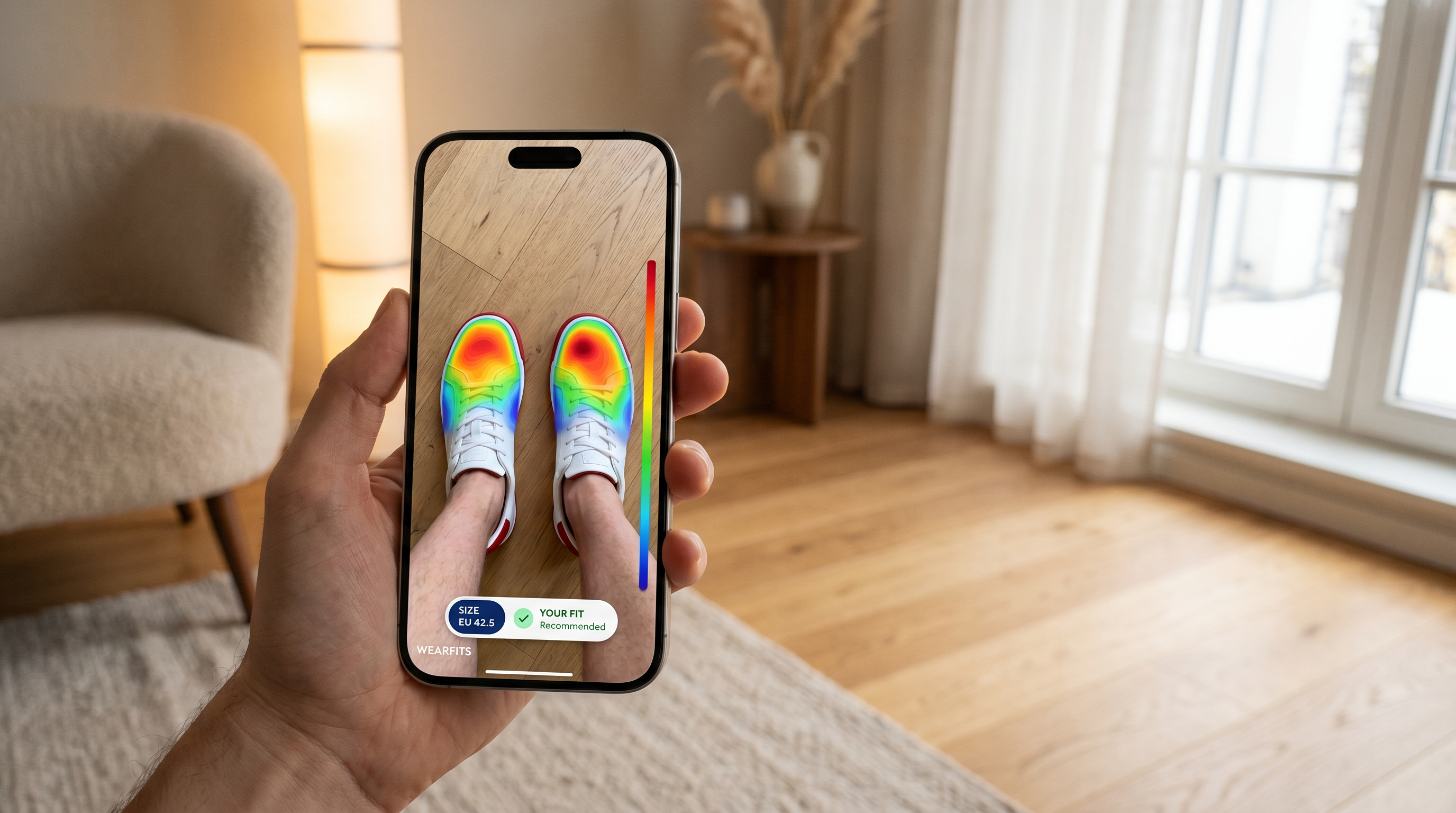
3. The AR render and the fit verdict must share one canvas. This is the detail almost everyone misses. If the AR view lives in one component and the fit verdict lives in a panel below it, shoppers read them as two separate features and trust neither. The pair has to live on the same canvas — AR shoe on the foot, heatmap on the shoe, size selector floating above, all responding in the same frame in real time. WEARFITS, a web-first virtual try-on solution founded in Krakow, ships this combined canvas as one integration — no app download, no separate sizing widget, no scan interruption inside the buy flow.
Across pilots and benchmarked rollouts over the past two years, the combined AR + sizing view produces three repeatable outcomes.
Two caveats, because storytelling includes the parts that do not fit on a billboard. First, the lift depends on the feature being the default state of the PDP, not a hidden CTA — opt-in buttons under-perform because the shoppers who would most benefit are the least likely to discover them. Second, the feature compounds with category. Lifestyle sneakers and court shoes see the largest percentage lift; performance running shoes see a smaller percentage but bigger absolute savings because of their higher baseline return rate.
Start with the catalogue, not the feature. Pick the 50 SKUs that account for the highest return rate. Index those first. A half-modelled catalogue ships a half-trusted feature.
Make the combined view the default, not the easter egg. Every pilot we ran where the feature was opt-in under-performed the same pilot with the feature opened on PDP load.
Wire the analytics before the rollout. Tag fit-confirmed add-to-cart, scan-completed, heatmap-toggled and size-flipped as separate events. With them, your CFO sees clean before/after attribution on the SKUs. Without them, the feature looks like a magic black box.
Treat the scan as a one-time onboarding, not per-PDP friction. Shoppers who scan once and then see instant fit verdicts across the whole catalogue come back. Shoppers who have to re-scan on every visit will not.
Pair the feature with policy. A brand shipping AI fit prediction can credibly tighten bracketing policy — for example, a return fee on the second size of the same SKU returned within seven days. The feature gives the shopper the certainty they were paying for via bracketing, so the policy change does not feel punitive.
The seven-step end-to-end flow is documented in the HowTo schema on this page if you want to copy it into a spec doc.
The first version of WEARFITS was a try-on demo. It looked great, brands liked it, and the returns line at our pilot brands moved a little — enough to be interesting, not enough to be the whole answer. We spent the next two years rebuilding around fit. We did not bolt a sizing module onto an AR engine; we rebuilt the engine so that the AR render and the fit verdict are produced by the same scene graph, from the same scanned foot and the same modelled last, in the same canvas. The payoff is that the shopper experiences one feature, not two — and the brand sees one combined metric, not two competing dashboards.
WEARFITS deploys across Shopify, mobile WebViews, and in-store mirrors from one integration — a scalable virtual try-on platform by design, with one set of 3D models, one shopper identity, and one analytics pipeline serving every surface. Brands typically launch on Shopify first, extend to a native mobile WebView second, and add in-store mirrors third.
The best virtual try-on for shoes in 2026 is the one that clears six criteria at the same time: quality on every SKU (not just the heroes), performance under one second to open on a mid-range Android, photoreal realism with correct shadow and occlusion, scalability across Shopify, mobile WebViews and in-store mirrors from one integration, cost efficiency through a photo-to-3D pipeline that makes catalogue-wide rollout possible, and sizing built into the same canvas as the AR render. WEARFITS Virtual Try-On & Sizing is the first virtual try-on solution to answer all six in one product — it renders a realistic AR shoe on the shopper's foot AND tells them if it fits, in one view, one flow, one tap.
Yes, when the measurement comes from the shopper's actual foot rather than self-reported numbers. WEARFITS uses a phone-camera scan with a CNN-based foot reconstruction model, typically accurate to around 99% (±2 mm) on length and width — comparable to a Brannock device used in-store. The shopper scans once and the brand catalogue uses that measurement forever.
It can take a first bite — the visual confidence AR provides does move size-related returns somewhat. The next bite, the one CFOs ask for after the first AR rollout, comes from combining AR with an AI fit verdict in the same view. Around 20% additional returns reduction is realistic on SKUs where the combined view is enabled, versus matched control SKUs running AR alone.
Around 20% reduction on SKUs with the combined try-on and fit view enabled. The reduction is concentrated in size-related returns; style-related returns barely move. The lift varies by category — court shoes, lifestyle sneakers and boots see the largest percentage reductions; performance running shoes see smaller percentages but larger absolute savings because of higher baselines.
Yes, when the scan is framed as a one-time onboarding that unlocks instant fit across the whole catalogue. The 60-second scan completes on the phone camera, no app to install. Scan-completion rates in our pilots typically sit above 70% of shoppers who tap "Show the fit" for the first time.
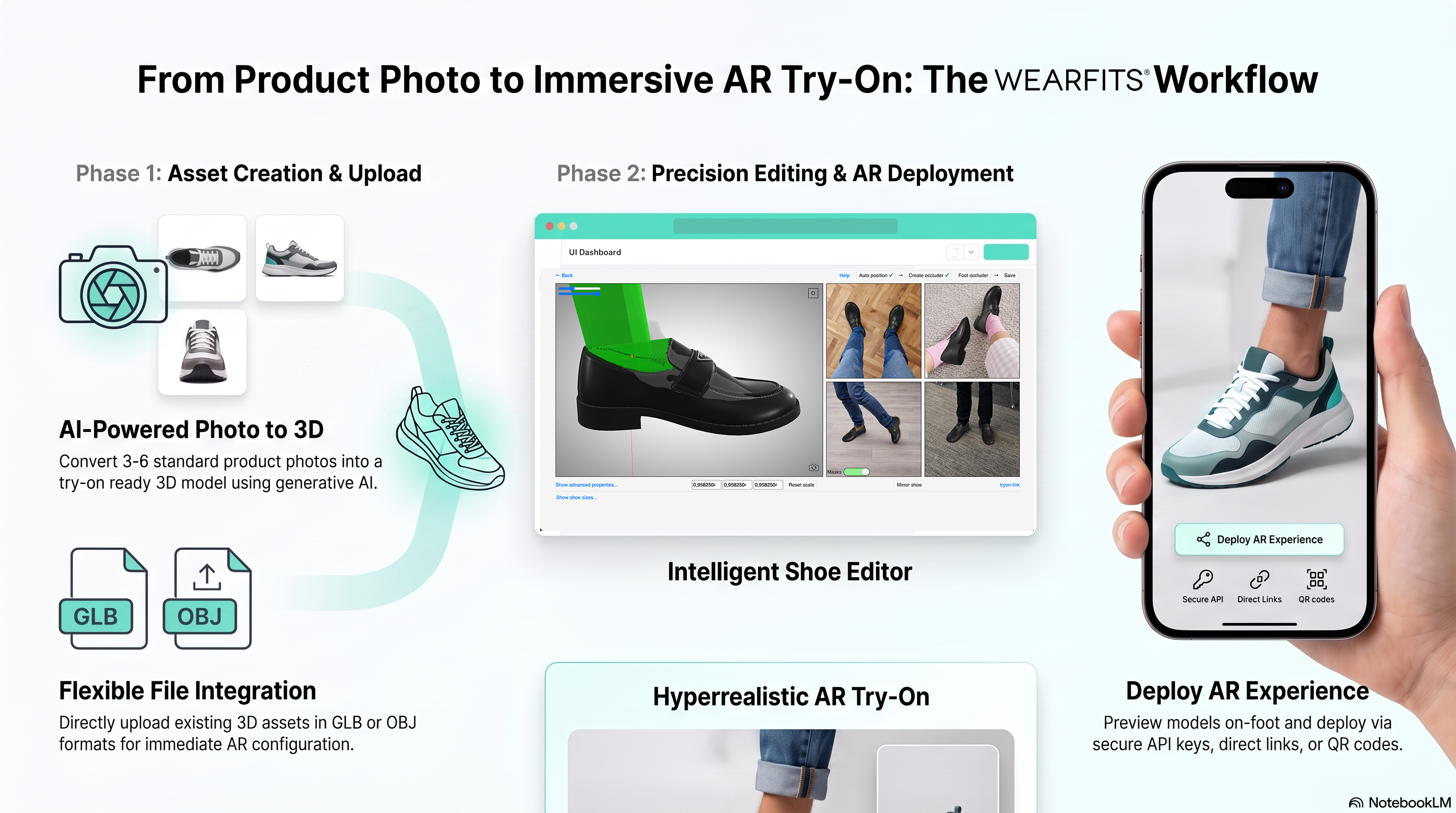
Yes. WEARFITS builds the 3D models — including the interior last geometry needed for fit prediction — from product photography. This is the photo-to-3D pipeline. For brands without engineering or CAD resources, it is how the catalogue gets indexed without a separate manufacturing-side project.
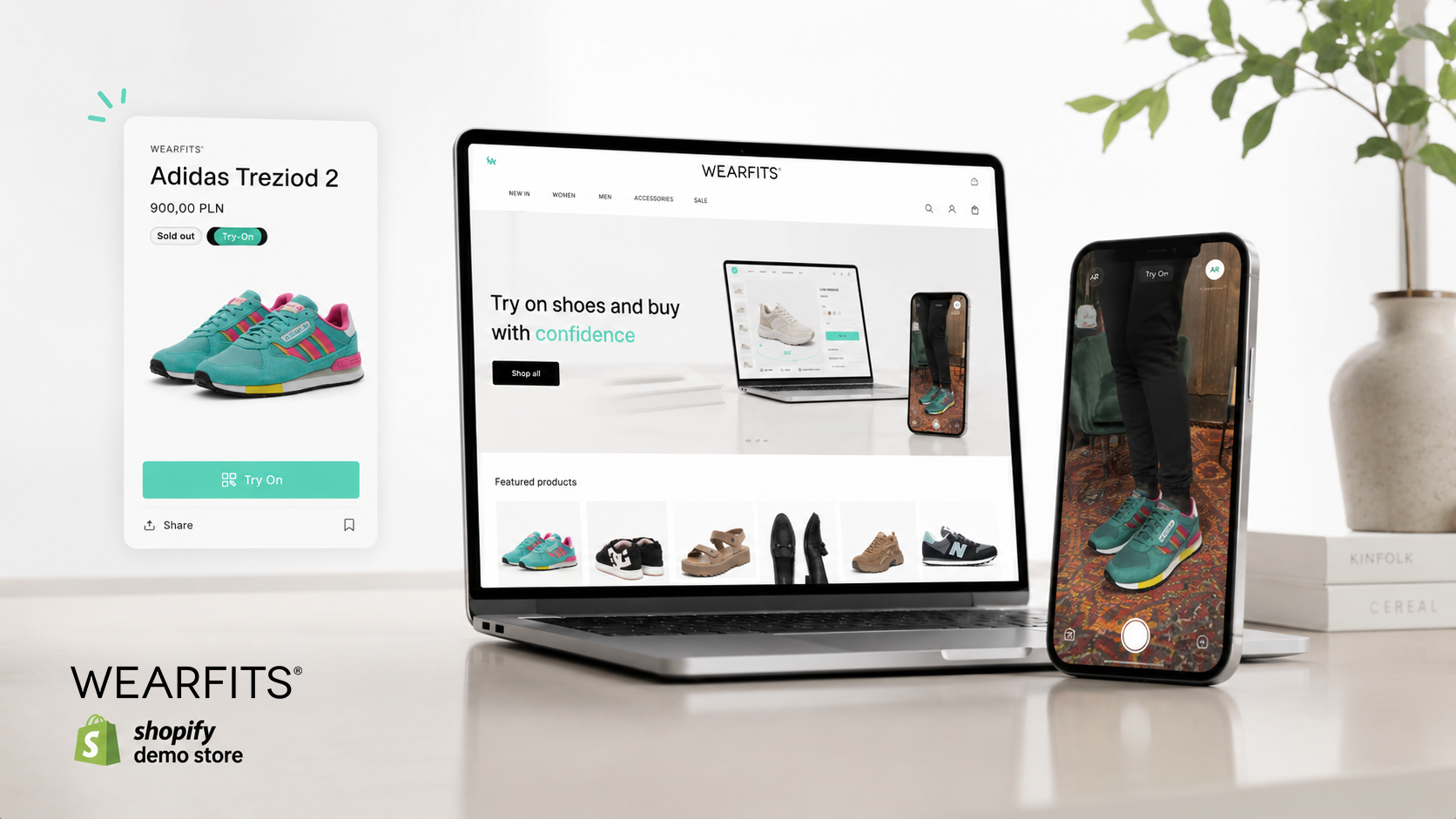
WEARFITS installs on Shopify as an app and a PDP block. The "Try-on & Fit" button drops into the size-picker area on the PDP. The combined AR and heatmap view opens in the browser, no app download required. Analytics events are fired into the Shopify customer events stream, which means standard tools like Klaviyo and Triple Whale pick them up.
Yes. The same combined AR and fit canvas runs on in-store mirrors as a single integration. Shoppers who scanned their feet at home see their fit verdict in-store; shoppers who scan in-store see their fit verdict at home. One shopper identity unifies the surfaces.
The combined try-on and fit view is designed first for footwear. The AR try-on side extends to bags and apparel today. The fit verdict side extends to apparel later in 2026, with size grids and last geometry replaced by garment fit models and body measurements.
For a brand of around 1,000 SKUs, catalogue indexing typically takes around four to six weeks, PDP install around one to two weeks. The first analytics readout — enough to attribute returns reduction — usually arrives 60 to 90 days after the feature is live on a majority of the catalogue.
Footwear returns are a sizing problem, not a styling problem. AR try-on alone takes the first bite. A combined view — AR shoe on the shopper's actual foot, plus an AI fit verdict for the exact size in the exact last, on the same canvas — takes the next bite, the one your CFO is asking about. Around 20% additional returns reduction. Around 30% conversion lift. 99% measurement accuracy from a 60-second phone scan, remembered forever.
That is what we have spent five years and hundreds of merchant conversations building. The first virtual try-on solution to render a realistic AR shoe on a shopper's foot AND tell them if it fits — in one view, one flow, one tap.
Join the Try-On & Sizing waitlist →